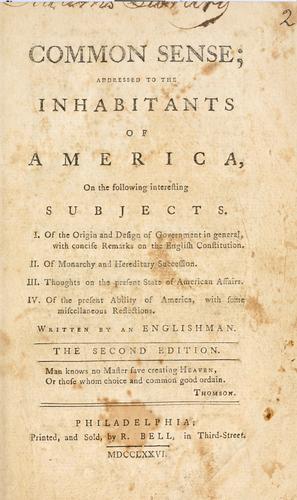
Common Sense
Thomas Paine (1776)
“A broke, self-taught immigrant writes 48 pages that convince an entire continent to declare independence — and publishes them anonymously because the argument matters more than the author.”
Common Sense— Summary & Analysis
by Thomas Paine · published 1776 · 48 pages · Romantic Period
A user-friendly study guide for Common Sense by Thomas Paine (1776): a high-level plot summary, full chapter-by-chapter analysis, theme breakdowns, character profiles, and 30 essay questions designed for high-school, ap-english, college readers. Unlike a stock summary, sumsumsum.com adds a diction analysis drawn from Thomas Paine’s actual text, the 5 documented AP Literature exam appearances of this book, and reading-difficulty guidance (Easy, 3/10) so students, teachers, and lifelong readers know what they are walking into.
“A broke, self-taught immigrant writes 48 pages that convince an entire continent to declare independence — and publishes them anonymously because the argument matters more than the author.”
Short Summary
Published anonymously in January 1776, Common Sense is the pamphlet that turned colonial grievance into revolutionary conviction. Thomas Paine — an English immigrant who had been in America barely fourteen months — argued in plain, furious prose that monarchy was absurd, hereditary succession was criminal, reconciliation with Britain was impossible, and independence was not merely an option but a moral obligation. Within three months, 150,000 copies were in circulation in a population of 2.5 million. Washington had it read aloud to his troops. It did not propose independence as a theoretical ideal; it demanded it as an immediate, practical necessity.
Detailed Summary
Common Sense arrived at exactly the moment the American colonies needed it. By January 1776, fighting had already broken out at Lexington and Concord, blood had been spilled at Bunker Hill, and yet the Continental Congress was still debating whether to reconcile with King George III. Most colonists ...
Summary in the Author’s Writing Style
A retelling of Common Sense in Thomas Paine’s style — so you can hear the language, not just the plot. This is a stylistic pastiche written by sumsumsum, not an excerpt from the book.
Some writers there are who would have us believe that society and government are one and the same thing. They are not. Society is produced by our wants, and government by our wickedness; the first is a patron, the last a punisher. The one encourages intercourse, the other creates distinctions. Let a…
Chapter-by-Chapter Analysis
If you liked Common Sense, read next
Start with The Declaration of Independence by Thomas Jefferson — Written six months after Common Sense and deeply influenced by it — Jefferson formalized Paine's popular rhetoric into legal-philosophical language that became the founding document of the nation. Then try Narrative of the Life of Frederick Douglass by Frederick Douglass — Douglass used the same revolutionary rhetoric against the institution Paine left unaddressed — turning America's founding language of liberty against its practice of slavery. Or pivot to Walden by Henry David Thoreau — Thoreau's civil disobedience descends directly from Paine's argument that citizens have the right and duty to resist unjust government.
For comparative essays, pair Common Sense with
The strongest comparative pairing is The Communist Manifesto (Karl Marx and Friedrich Engels) — The most influential political pamphlet after Common Sense — same short form, same urgency, same argument that the current system must be replaced rather than reformed. For a third angle, contrast with Letter from Birmingham Jail (Martin Luther King Jr.) — King's defense of direct action echoes Paine's argument that delay is cowardice and that unjust laws deserve no obedience — the civil rights movement's Common Sense.
Each of these pairings opens a clean thesis path on shared themes, period diction, or formal influence — useful for AP Lit / IB / first-year college comparative essays.