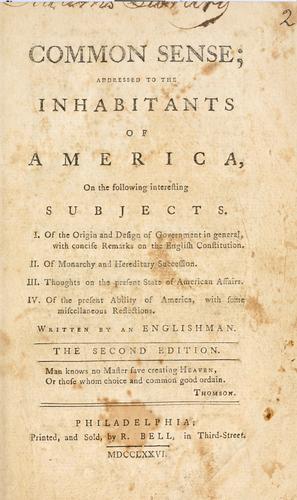
Common Sense
Thomas Paine (1776)
“A broke, self-taught immigrant writes 48 pages that convince an entire continent to declare independence — and publishes them anonymously because the argument matters more than the author.”
Language Register
Deliberately low for its genre — Paine rejects the Latinate, legalistic prose of prior political philosophy in favor of short sentences, common metaphors, direct address, and controlled insult. The plainness is itself a political act: it says that political truth belongs to everyone.
Syntax Profile
Paine writes in short, punching sentences that build to longer periodic climaxes. His paragraphs typically open with a claim, support it with one or two illustrations, then close with an epigram. The rhythm is closer to a sermon than an essay — cumulative, repetitive, designed for reading aloud. He uses rhetorical questions constantly, forcing the reader to supply the answer he wants. His semicolons chain related propositions into arguments that feel inevitable rather than constructed.
Figurative Language
Moderate but concentrated — Paine's metaphors are few and repeated for maximum impact. The parent-child metaphor (Britain/America) is seized and reversed. The merchant-goods metaphor replaces the family metaphor. The prostitution metaphor makes reconciliation obscene. Each image does a specific job and then Paine moves on. He does not decorate; he deploys.
Era-Specific Language
Abbreviation of 'videlicet' (Latin: namely) — one of Paine's few concessions to formal prose convention
Archaic form of 'has' — Paine uses biblical verb forms when he wants scriptural authority
18th-century spelling of 'connection' — the colonial relationship with Britain
The standard metaphor for Britain's relationship to the colonies — Paine uses it only to demolish it
Referring to all thirteen colonies collectively — a term that asserted unity before independence made it official
How Characters Speak — Class & Identity
Paine as narrator
First person plural ('we') throughout — never 'I argue' but 'we see.' Common vocabulary, short sentences, no classical quotation except the Bible. Presents himself as one citizen reasoning with equals.
Paine was self-educated, a former corset-maker and tax collector. His prose reflects his class origins and makes a virtue of them. He writes as a workingman addressing workingmen, and his authority comes from reason rather than credentials.
The colonial reader (implicit)
Addressed directly: 'Hath your house been burnt?' The reader is assumed to be literate but not learned, religious but not clerical, practical and working. Paine never assumes knowledge of Locke, Montesquieu, or classical philosophy.
Paine's audience is the ordinary colonial citizen who had never read a political treatise and never expected to. The pamphlet's success proves this audience existed in enormous numbers and was waiting for someone to speak to them directly.
King George III (target)
Referred to with deliberate disrespect — 'the Royal Brute of Britain,' not by title. Stripped of ceremonial language and reduced to his actions: making war, taxing, oppressing.
Paine's attack on the king's person, not just his policies, was the pamphlet's most radical rhetorical move. Prior colonial protests had blamed Parliament or ministers while preserving the fiction of a benevolent monarch. Paine destroys the fiction.
The reconciliation advocates
Presented as cowards, fools, or men with economic interests in continued British rule. Their arguments are quoted only to be demolished. They are never given the dignity of a fair hearing.
Paine's rhetorical strategy requires a domestic enemy — the Loyalist or the fence-sitter — whose position is presented as not merely wrong but morally contemptible. This is persuasion by social pressure: no reader wants to be in the group Paine is mocking.
Narrator's Voice
Thomas Paine — first person plural, prophetic, furious, strategically plain. He writes as 'we' because the argument is meant to feel like consensus rather than advocacy. His authority derives entirely from the argument itself — he claims no credentials, no rank, no special knowledge. He is an Englishman who can see what Americans cannot because they are too close to the problem. The voice is simultaneously humble (I am nobody) and audacious (I am telling you to overthrow your government).
Tone Progression
Section 1 — Of Government and the English Constitution
Philosophical and measured
Paine at his calmest — establishing principles before applying them. The prose is logical, sequential, almost gentle in its demolition of the English Constitution.
Section 2 — Of Monarchy and Hereditary Succession
Satirical and aggressive
The gloves come off. Paine moves from philosophy to attack, using ridicule, biblical authority, and personal insult to destroy the institution of monarchy.
Section 3 — Thoughts on the Present State of American Affairs
Urgent and emotional
The strategic center. Paine demolishes reconciliation arguments with increasing intensity, culminating in the invocation of burned houses and dead children.
Section 4 — Of the Present Ability of America
Prophetic and visionary
Paine shifts from what must be destroyed to what can be built. The prose moves between practical calculation and millennial hope — 'we have it in our power to begin the world over again.'
Stylistic Comparisons
- Luther's 95 Theses — another short document that ignited a revolution by making complex theology available in plain language
- The Declaration of Independence — Jefferson's more formal document draws on Paine's arguments and sometimes his exact phrases, but elevates the register to legal-philosophical
- Frederick Douglass's 'What to the Slave is the Fourth of July?' — the same strategy of turning America's founding rhetoric against its practice, with the same controlled fury
Key Vocabulary from This Book
Notable words used in this text — click to see full definitions