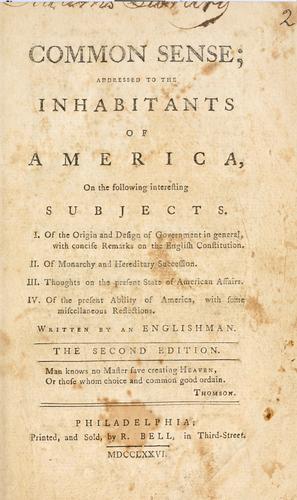
Common Sense
Thomas Paine (1776)
“A broke, self-taught immigrant writes 48 pages that convince an entire continent to declare independence — and publishes them anonymously because the argument matters more than the author.”
Why This Book Matters
Common Sense is the most influential political pamphlet in American history and arguably in the history of the English language. It sold approximately 150,000 copies within three months of publication — in a colonial population of 2.5 million, roughly one copy for every sixteen people, the equivalent of selling 20 million copies today. More importantly, it changed the terms of the debate. Before Common Sense, the question was whether to reconcile with Britain on better terms. After Common Sense, the question was how to build a new nation. The Declaration of Independence, drafted six months later, echoes Paine's arguments, his rhetoric, and sometimes his exact phrases. John Adams admitted that without Paine's pen, Washington's sword would have been raised in vain.
Firsts & Innovations
The first political text to argue for American independence to a mass audience in accessible language
The first work of political philosophy written deliberately for common citizens rather than educated elites
One of the first texts to propose a written constitution and representative government as a practical alternative to monarchy
The best-selling American publication of the 18th century relative to population size
Cultural Impact
Directly catalyzed the Declaration of Independence — Jefferson and Adams both acknowledged Common Sense as a turning point
Established the pamphlet as the dominant form of revolutionary political communication — imitated in every subsequent revolution
Created the rhetorical framework of American exceptionalism — America as an experiment for all mankind
Influenced the French Revolution — Paine himself participated and was elected to the National Convention
The phrase 'common sense' became shorthand for the democratic idea that political truth is accessible to everyone
Demonstrated that anonymous publication could be a strategic tool — the argument mattered, not the author
The 'mother country' metaphor reversal became a template for anti-colonial rhetoric worldwide
Banned & Challenged
Common Sense was seditious literature in Britain — possession could result in prosecution. It was suppressed in British-controlled territories throughout the Revolution. In the 19th century, Paine's reputation was attacked more for The Age of Reason (his anti-religious work) than for Common Sense, but the two were often conflated. Theodore Roosevelt called Paine a 'filthy little atheist.' The pamphlet has never been banned in the United States but has been periodically controversial for its radical implications — its argument that citizens have the right to overthrow any government that fails them remains more radical than most American politicians would admit.