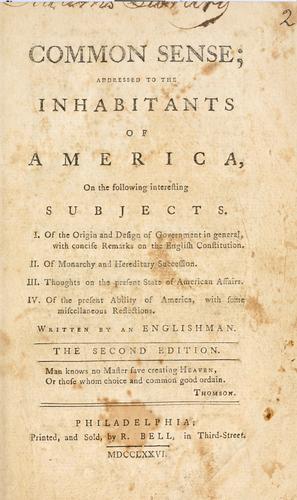
Common Sense
Thomas Paine (1776)
“A broke, self-taught immigrant writes 48 pages that convince an entire continent to declare independence — and publishes them anonymously because the argument matters more than the author.”
Essay Questions & Food for Thought
30questions designed to challenge assumptions and provoke original thinking. These can't be answered from a summary — you need the actual text.
Paine opens Common Sense by distinguishing between society and government — calling society 'a blessing' and government 'a necessary evil.' What is the practical consequence of this distinction? If government is only justified by human wickedness, what happens when government itself becomes wicked?
Paine wrote Common Sense in plain, short sentences that any literate colonist could follow. Why was this stylistic choice as revolutionary as the political argument? What does the prose style itself argue about who gets to participate in political debate?
Paine uses the Bible — particularly 1 Samuel 8, where God condemns monarchy — as evidence against kingship. He later wrote The Age of Reason, attacking organized religion. Does knowing about his later anti-religious views change how you read his biblical arguments in Common Sense?
Paine calls William the Conqueror 'a French bastard landing with an armed banditti.' Why does he attack the origin of English monarchy rather than just its current exercise? What happens to an institution when its founding moment is exposed as illegitimate?
Paine published anonymously and donated his royalties. How does the absence of an author change how readers receive the argument? Is Common Sense more or less persuasive because it appeared to be 'written by an Englishman' rather than by Thomas Paine?
Before Common Sense, most colonists blamed Parliament or the king's ministers for their grievances while maintaining loyalty to the king himself. How does Paine destroy this distinction? Why was attacking the king personally — not just his policies — the pamphlet's most radical move?
Paine seizes the 'mother country' metaphor and reverses it: 'We may as well assert that because a child has thrived upon milk, that it is never to have meat.' Find another metaphor Paine captures from the pro-British side and reverses. What makes metaphor-reversal such an effective rhetorical technique?
Paine says reconciliation with Britain is impossible: 'Can ye give to prostitution its former innocence? Neither can ye reconcile Britain and America.' Is this a fair comparison? What is Paine doing by using sexual violation as a metaphor for political oppression?
Common Sense sold 150,000 copies in three months in a population of 2.5 million. What would the equivalent be today? What modern medium could produce this level of political conversion — and has anything done so?
Paine argues that America's geographic distance from Europe is an advantage: an independent America would be courted by every European trading partner. Was this prediction accurate? How did America's geographic isolation shape its early foreign policy?
Paine invokes the recent violence — burned houses, dead children, destitute families — as evidence that reconciliation is impossible. Is this a logical argument or an emotional manipulation? Can it be both?
'The cause of America is in a great measure the cause of all mankind.' Paine wrote this in 1776. Was he right? Has the American experiment served the cause of all mankind — or has it served primarily the cause of America?
Paine was an Englishman who had been in America only 14 months when he published Common Sense. Does his outsider status strengthen or weaken his argument? Can an outsider see a situation more clearly than those living inside it?
Paine's final section proposes a practical framework for a new government — a Continental Congress, a rotating presidency, supermajority requirements, a written constitution. How close is his proposal to what the Founders actually built? What did they adopt and what did they change?
Paine writes: 'We have it in our power to begin the world over again.' Is this the most inspiring or the most dangerous sentence in American political writing? What happens when a nation believes it can start from scratch?
Compare Paine's attack on monarchy in Common Sense with his later defense of the French king's life during the French Revolution (he voted against executing Louis XVI). How do you reconcile these two positions? Can someone who calls all kings tyrants also argue that a specific king should not be killed?
Six people attended Paine's funeral in 1809. The man who helped start a revolution died impoverished and forgotten. What does this say about the relationship between revolutionary writers and the revolutions they help create?
Paine deliberately refuses to be fair to the pro-British position. He does not 'both sides' the argument. Is this a strength or a weakness? When is one-sided argument justified — and when does it become propaganda?
Paine argues that hereditary succession is absurd because 'nature disapproves it' — talented parents produce mediocre children. Apply this argument to modern systems of inherited advantage: wealth, social connections, educational access. Does Paine's logic extend beyond monarchy?
Common Sense uses 'we' throughout — never 'I.' What is the political function of this pronoun choice? How does speaking as 'we' make the reader feel like a participant rather than an audience?
Paine had no formal education past age 13. Compare Common Sense to the Declaration of Independence, written by the university-educated Jefferson. What does the comparison reveal about the relationship between education, writing style, and persuasive power?
Paine's argument depends on urgency — 'the present time is that peculiar time which never happens to a nation but once.' Is this genuine urgency or manufactured urgency? How can a reader distinguish between 'we must act now because the moment is unique' and 'I want you to act before you think too carefully'?
Common Sense argues that America should have no king. But Washington was later offered kingship (and refused), and the presidency has accumulated enormous power. Has America avoided the concentration of power Paine warned against — or has it merely renamed it?
Paine writes that the colonies should build a navy because 'no country on the globe is so happily situated for building a fleet.' His argument for independence includes detailed military and economic calculations alongside moral philosophy. Why does he mix practical logistics with grand principle?
Common Sense was read aloud in taverns, churches, and army camps. How does writing designed for oral performance differ from writing designed for silent reading? Find passages in Common Sense that work better when read aloud than on the page.
Paine's pamphlet was written for a specific audience (American colonists in 1776) facing a specific decision (independence or reconciliation). Can a text this politically specific also be universally relevant? What transfers across centuries, and what does not?
Paine argues that God opposes monarchy based on 1 Samuel 8. But many monarchs claimed divine right — the idea that God had specifically chosen them to rule. How does Paine handle the fact that the Bible can be cited on both sides of the argument?
Common Sense was published in January 1776. The Declaration of Independence was signed in July 1776. In those six months, how did public opinion shift — and how much of that shift was caused by Paine versus caused by events (British military escalation, the king's rejection of the Olive Branch Petition)?
Paine donated his royalties to the Continental Army and died impoverished. In modern terms, this is like a writer going viral with the most important political argument of the century and refusing to monetize it. What does this decision reveal about Paine's relationship to his own argument?
Write a modern Common Sense — a one-page argument for a political change you believe is obvious but that most people resist. Use Paine's techniques: begin with first principles, attack the opposing position's foundations (not just its details), use emotional and biblical/moral authority, create urgency, and end with a practical proposal. Then analyze your own rhetoric: where are you being fair, and where are you being manipulative?