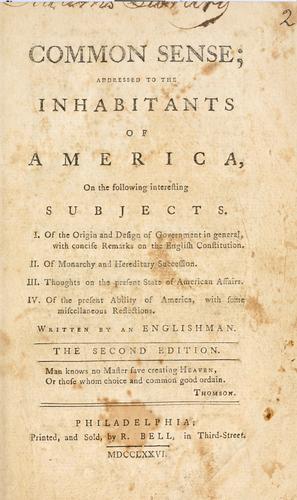
Common Sense
Thomas Paine (1776)
“A broke, self-taught immigrant writes 48 pages that convince an entire continent to declare independence — and publishes them anonymously because the argument matters more than the author.”
This page prints on a single page. Use Ctrl+P / Cmd+P.
Common Sense
Thomas Paine (1776) · 48pages · Romantic Period · 5 AP appearances
Summary
Published anonymously in January 1776, Common Sense is the pamphlet that turned colonial grievance into revolutionary conviction. Thomas Paine — an English immigrant who had been in America barely fourteen months — argued in plain, furious prose that monarchy was absurd, hereditary succession was criminal, reconciliation with Britain was impossible, and independence was not merely an option but a moral obligation. Within three months, 150,000 copies were in circulation in a population of 2.5 million. Washington had it read aloud to his troops. It did not propose independence as a theoretical ideal; it demanded it as an immediate, practical necessity.
Why It Matters
Common Sense is the most influential political pamphlet in American history and arguably in the history of the English language. It sold approximately 150,000 copies within three months of publication — in a colonial population of 2.5 million, roughly one copy for every sixteen people, the equiva...
Themes & Motifs
Diction & Style
Register: Deliberately low for its genre — Paine rejects the Latinate, legalistic prose of prior political philosophy in favor of short sentences, common metaphors, direct address, and controlled insult. The plainness is itself a political act: it says that political truth belongs to everyone.
Narrator: Thomas Paine — first person plural, prophetic, furious, strategically plain. He writes as 'we' because the argument i...
Figurative Language: Moderate but concentrated
Historical Context
The American Revolution — 1774-1776, the eighteen months between Paine's arrival and the Declaration of Independence: Common Sense was published at the precise moment when the American colonies were fighting a war they had not yet decided to fight. Troops were in the field, blood had been spilled, the king had dec...
Key Characters
Talking Points
- Paine opens Common Sense by distinguishing between society and government — calling society 'a blessing' and government 'a necessary evil.' What is the practical consequence of this distinction? If government is only justified by human wickedness, what happens when government itself becomes wicked?
- Paine wrote Common Sense in plain, short sentences that any literate colonist could follow. Why was this stylistic choice as revolutionary as the political argument? What does the prose style itself argue about who gets to participate in political debate?
- Paine uses the Bible — particularly 1 Samuel 8, where God condemns monarchy — as evidence against kingship. He later wrote The Age of Reason, attacking organized religion. Does knowing about his later anti-religious views change how you read his biblical arguments in Common Sense?
- Paine calls William the Conqueror 'a French bastard landing with an armed banditti.' Why does he attack the origin of English monarchy rather than just its current exercise? What happens to an institution when its founding moment is exposed as illegitimate?
- Paine published anonymously and donated his royalties. How does the absence of an author change how readers receive the argument? Is Common Sense more or less persuasive because it appeared to be 'written by an Englishman' rather than by Thomas Paine?
Notable Quotes
“Society is produced by our wants, and government by our wickedness; the former promotes our happiness POSITIVELY by uniting our affections, the lat...”
“Government, even in its best state, is but a necessary evil; in its worst state, an intolerable one.”
“To say that the constitution of England is a union of three powers, reciprocally checking each other, is farcical; either the words have no meaning...”
Why Read This
Because every political argument you will ever encounter uses the same tools Paine used — appeal to principle, appeal to emotion, appeal to self-interest, appeal to urgency — and Common Sense is short enough to watch all of them deployed in 48 pag...