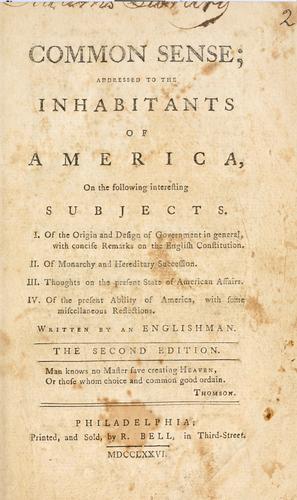
Common Sense
Thomas Paine (1776)
“A broke, self-taught immigrant writes 48 pages that convince an entire continent to declare independence — and publishes them anonymously because the argument matters more than the author.”
Common Sense— Historical Context & Author Background
Author: Thomas Paine · Published 1776· Era: Romantic Period·48 pages
Themes explored: freedom, democracy, revolution, power, justice, courage
About Thomas Paine
Thomas Paine (1737-1809) was born in Thetford, England, the son of a Quaker corset-maker. He left school at thirteen, failed at multiple trades (corset-making, privateer sailor, tax collector, tobacconist), went through two marriages (one wife died, one ended in separation), and was twice dismissed from the excise service for agitation. He was, by every measure of 18th-century English society, a failure. In 1774, at age 37, he met Benjamin Franklin in London, who wrote him a letter of introduction to people in Philadelphia. Paine arrived in America in November 1774 with nothing but Franklin's letter and a case of typhoid fever he contracted on the ship. Fourteen months later, he published Common Sense — a pamphlet that sold more copies relative to the population than any publication in American history. He donated his royalties to the Continental Army, served as a common soldier and war correspondent (writing The American Crisis series, which begins 'These are the times that try men's souls'), and was given a farm by the state of New York after the war. He then went to France, participated in the French Revolution, was elected to the National Convention despite not speaking French, voted against the execution of Louis XVI (arguing for exile), was imprisoned during the Terror, and nearly executed. In prison he wrote The Age of Reason, an attack on organized religion that destroyed his reputation in America. He returned to the United States in 1802, impoverished and despised by the religious establishment. He died in New York in 1809. Six people attended his funeral.
Life → Text Connections
How Thomas Paine's real experiences shaped specific elements of Common Sense.
Paine was a self-educated former corset-maker with no university training
Common Sense's plain style is not a literary choice — it is the voice of a man who never learned to write in the ornate style of the educated elite
The pamphlet's accessibility was inseparable from its author's class origins. A Harvard-trained lawyer would not have written Common Sense this way — and it would not have sold 150,000 copies if he had.
Paine had been in America only 14 months when he published Common Sense
The outsider's perspective is the pamphlet's analytical advantage — Paine could see what native-born colonists had normalized
Paine's status as a recent immigrant gave him clarity about the absurdity of the colonial situation. He had not grown up revering the English Constitution or feeling emotional loyalty to the Crown. He arrived, looked at the situation, and asked: Why are you people putting up with this?
Paine published anonymously and donated his royalties to the Continental Army
The anonymity made the argument appear as universal common sense rather than one man's polemic
By removing himself from the text, Paine made the pamphlet belong to its readers. Common Sense was not Paine's opinion — it was what any honest person would conclude. This rhetorical strategy was as revolutionary as the political argument.
Paine later wrote The Age of Reason, which attacked organized religion and destroyed his American reputation
Common Sense uses biblical authority strategically — the same man who deployed scripture to convince colonists would later argue that scripture was unreliable
Paine's use of the Bible in Common Sense was tactical, not devotional. He used the authority his audience recognized, not the authority he personally accepted. This makes the pamphlet's rhetorical strategy more sophisticated — and more manipulative — than it appears.
Six people attended Paine's funeral in 1809 — thirty-three years after Common Sense made him the most influential writer in America
The man who wrote 'we have it in our power to begin the world over again' died impoverished and forgotten
Paine's life is the dark counterargument to Common Sense's optimism. The revolution he helped create had no use for him once it was complete. Revolutionaries are necessary and then discarded — a pattern Paine did not predict in his pamphlet.
Historical Era
The American Revolution — 1774-1776, the eighteen months between Paine's arrival and the Declaration of Independence
How the Era Shapes the Book
Common Sense was published at the precise moment when the American colonies were fighting a war they had not yet decided to fight. Troops were in the field, blood had been spilled, the king had declared them rebels — and yet the Continental Congress was still debating whether to seek reconciliation. This cognitive dissonance between action and intention was what Paine exploited. He did not create the revolutionary impulse — he gave it a language and a logic. The pamphlet's timing was perfect because the audience was already emotionally ready for the argument but had not yet heard it stated plainly. Within six months of publication, the Continental Congress declared independence using arguments Paine had made common currency.
Why Common Sense Matters Historically
Common Sense is the most influential political pamphlet in American history and arguably in the history of the English language. It sold approximately 150,000 copies within three months of publication — in a colonial population of 2.5 million, roughly one copy for every sixteen people, the equivalent of selling 20 million copies today. More importantly, it changed the terms of the debate. Before Common Sense, the question was whether to reconcile with Britain on better terms. After Common Sense, the question was how to build a new nation. The Declaration of Independence, drafted six months later, echoes Paine's arguments, his rhetoric, and sometimes his exact phrases. John Adams admitted that without Paine's pen, Washington's sword would have been raised in vain.
- The first political text to argue for American independence to a mass audience in accessible language
- The first work of political philosophy written deliberately for common citizens rather than educated elites
- One of the first texts to propose a written constitution and representative government as a practical alternative to monarchy
- The best-selling American publication of the 18th century relative to population size
Common Sense was seditious literature in Britain — possession could result in prosecution. It was suppressed in British-controlled territories throughout the Revolution. In the 19th century, Paine's reputation was attacked more for The Age of Reason (his anti-religious work) than for Common Sense, but the two were often conflated. Theodore Roosevelt called Paine a 'filthy little atheist.' The pamphlet has never been banned in the United States but has been periodically controversial for its radical implications — its argument that citizens have the right to overthrow any government that fails them remains more radical than most American politicians would admit.