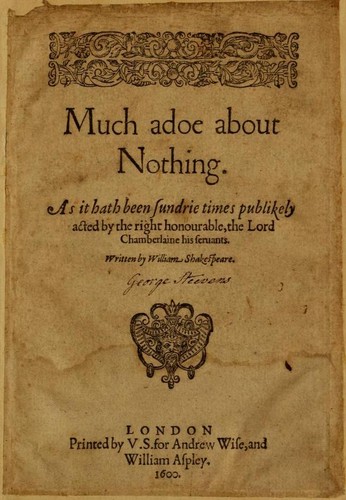
Much Ado About Nothing
William Shakespeare (1599)
“Shakespeare's sharpest romantic comedy asks whether the people who mock love the loudest are the ones who need it most.”
This page prints on a single page. Use Ctrl+P / Cmd+P.
Much Ado About Nothing
William Shakespeare (1599) · 80pages · Renaissance / Elizabethan · 5 AP appearances
Summary
Soldiers return from war to Messina, where the witty Beatrice and Benedick wage a war of words while denying their mutual attraction. Their friends conspire to trick each pair into confessing love. Meanwhile, the young lovers Hero and Claudio face a darker plot: the villainous Don John fabricates evidence of Hero's infidelity, leading Claudio to publicly shame her at the altar. Hero feigns death, the bumbling constable Dogberry accidentally uncovers the conspiracy, and all is set right. The play ends with two weddings and the arrest of Don John, but the damage of slander lingers beneath the celebration.
Why It Matters
Much Ado About Nothing is the foundational text of the romantic comedy as we know it. The formula it establishes -- two people who obviously belong together but cannot admit it, forced into revelation through the interference of friends, complications, and their own stubbornness -- is the templat...
Themes & Motifs
Diction & Style
Register: Predominantly prose -- the most prose-heavy play in the Shakespeare canon. Verse appears for serious emotional moments and formal ceremonies, but the play's center of gravity is conversational, rapid, and intellectually competitive.
Narrator: No narrator -- the play operates through dialogue, soliloquy, and the audience's ability to hold multiple layers of d...
Figurative Language: Moderate but precisely targeted. The play's central image clusters: war/combat (love as battle, wit as weaponry), disease/infection (slander as poison that spreads through a community), appearance/surface (oranges rotten inside, masked faces, veiled brides). Shakespeare uses fewer extended metaphors than in the tragedies but deploys individual images with surgical effect -- 'rotten orange,' 'Kill Claudio,' 'taming my wild heart.'
Historical Context
Late Elizabethan England, c. 1598-1599 -- the final years of Elizabeth I's reign, a period of cultural confidence and political anxiety: Much Ado About Nothing is a product of a culture where honor was not metaphorical but lethal. A public accusation of unchastity could destroy a woman's life -- not figuratively but literally, throu...
Key Characters
Talking Points
- Beatrice and Benedick resist love through wit and mockery. Claudio and Hero express love through silence and convention. Which couple has the more honest relationship? Which has the more durable one? Use specific scenes to support your argument.
- The title 'Much Ado About Nothing' contains a pun: 'nothing' and 'noting' (observing) were near-homonyms in Elizabethan English. How does this pun illuminate the play's structure? What is being 'noted' throughout, and by whom?
- Claudio shames Hero publicly at the altar rather than confronting her privately. Why does he choose a public setting? What does that choice reveal about his understanding of love versus honor?
- Leonato, Hero's father, instantly believes the accusation against her and wishes her dead. Why? What does his reaction reveal about the relationship between fathers, daughters, and honor in this society?
- Beatrice says 'O that I were a man!' after the shaming of Hero. Why can't she act? What structural barrier prevents her from challenging Claudio directly, and how does this constraint shape her relationship with Benedick?
Notable Quotes
“I would my horse had the speed of your tongue, and so good a continuer. But keep your way, i' God's name; I have done.”
“Can the world buy such a jewel?”
“I had rather hear my dog bark at a crow than a man swear he loves me.”
Why Read This
Because Beatrice and Benedick are the first version of every romantic comedy couple you have ever seen -- the ones who fight because they are afraid to feel, who use humor as armor, who need their friends to trick them into admitting what the audi...