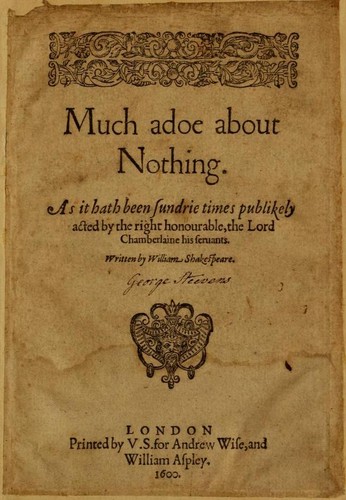
Much Ado About Nothing
William Shakespeare (1599)
“Shakespeare's sharpest romantic comedy asks whether the people who mock love the loudest are the ones who need it most.”
Essay Questions & Food for Thought
30questions designed to challenge assumptions and provoke original thinking. These can't be answered from a summary — you need the actual text.
Beatrice and Benedick resist love through wit and mockery. Claudio and Hero express love through silence and convention. Which couple has the more honest relationship? Which has the more durable one? Use specific scenes to support your argument.
The title 'Much Ado About Nothing' contains a pun: 'nothing' and 'noting' (observing) were near-homonyms in Elizabethan English. How does this pun illuminate the play's structure? What is being 'noted' throughout, and by whom?
Claudio shames Hero publicly at the altar rather than confronting her privately. Why does he choose a public setting? What does that choice reveal about his understanding of love versus honor?
Leonato, Hero's father, instantly believes the accusation against her and wishes her dead. Why? What does his reaction reveal about the relationship between fathers, daughters, and honor in this society?
Beatrice says 'O that I were a man!' after the shaming of Hero. Why can't she act? What structural barrier prevents her from challenging Claudio directly, and how does this constraint shape her relationship with Benedick?
'Kill Claudio.' These two words transform the play. Analyze this moment: what is Beatrice asking for, what does it cost Benedick to agree, and why is this the real test of their love rather than the gulling scenes?
Dogberry has the truth about Don John's plot but cannot communicate it effectively. What prevents him from being heard? Is it his language, his social class, or both? What is Shakespeare saying about who gets to be believed?
Don John is described as 'a plain-dealing villain' with almost no psychological depth. Why does Shakespeare make the villain so thin? Does the play need a brilliant villain, or does the honor system do Don John's work for him?
Hero barely speaks in her own play. Count her lines in the shaming scene, the death-feigning, and her restoration. What does her silence mean? Is it Shakespeare's failure to give her a voice, or a deliberate indictment of a society that never lets her speak?
The gulling of Beatrice and Benedick works because the lie contains the truth -- they do love each other. Don John's slander works because the lie exploits an existing anxiety -- male fear of female infidelity. Compare these two deceptions. What makes one benevolent and the other destructive?
Claudio's penance for shaming Hero consists of mourning at her tomb and singing an epitaph. Is this sufficient? He never speaks to Hero about what he did, never examines his own credulity, and is forgiven in approximately four lines. Does the play want us to find this adequate?
Benedick begins the play as a misogynist bachelor and ends it challenging his best friend on behalf of a wronged woman. Map his transformation scene by scene. Where does the real change happen -- the gulling, the confession to Beatrice, or the 'Kill Claudio' moment?
The play is set in Messina, Sicily -- an Italian setting for an English audience. Why Italy? What does the Italian setting allow Shakespeare to do that an English setting would not?
Compare the shaming of Hero to modern online shaming or cancel culture. In both cases, an accusation spreads instantly, the accused has limited ability to respond, and the truth arrives after the damage is done. What structural similarities exist between Messina's honor culture and social media?
Dogberry's malapropisms ('comprehend' for 'apprehend,' 'dissembly' for 'assembly') often accidentally create more accurate meanings than the words he intended. Find three malapropisms and argue that the 'wrong' word is actually more truthful than the 'right' one.
Beatrice and Benedick speak almost exclusively in prose. Claudio and Hero speak mostly in verse. What does the prose/verse divide tell us about each couple's relationship to social convention, emotional authenticity, and performance?
Don Pedro proposes the gulling scheme to trick Beatrice and Benedick into love. He also confirms the false accusation against Hero. How should we read Don Pedro -- as benevolent matchmaker or careless authority? Can he be both?
The play ends with a dance. But Hero has been publicly shamed, feigned death, and been restored without ever expressing anger or receiving a genuine apology. Is the comic ending earned? What would a more honest ending look like?
Margaret, Hero's gentlewoman, was the woman at the window with Borachio -- but she appears to have been unknowingly used in the plot. The play never punishes her or fully explains her role. Why does Shakespeare leave this loose thread? What would resolving it require?
Shakespeare wrote Othello a few years after Much Ado About Nothing. Both plays involve a man deceived into believing a woman is unfaithful, with catastrophic consequences. Compare Claudio to Othello and Don John to Iago. What does the comparison reveal about how genre (comedy vs. tragedy) shapes the same basic plot?
Benedick tells Don Pedro at the end: 'Prince, thou art sad. Get thee a wife.' Don Pedro, the most powerful man in the play, ends alone. Is this a comic detail or something more significant? What does Don Pedro's solitude mean?
The word 'nothing' in the title also meant 'noting' (observing/eavesdropping) AND was Elizabethan slang for female genitalia. If all three meanings are active, what is the play 'about' according to its own title?
Beatrice tells Benedick 'I was born to speak all mirth and no matter.' Is this true? Does Beatrice ever speak 'matter' (substance)? When does her language shift from performance to purpose?
In the gulling scenes, Beatrice and Benedick each believe the other loves them based on staged conversations they overheard. But the audience knows the conversations were lies. At what point do the lies become truth? Can a trick produce genuine feeling?
Imagine the play from Hero's perspective only. She falls in love, is betrothed, is publicly shamed for something she did not do, must feign death, and is restored without anyone ever asking how she feels. Write the version of Act IV, Scene 1 that Hero would tell.
The Friar proposes Hero feign death so that guilt will 'change slander to remorse.' His plan depends on the idea that Claudio will feel worse about a dead Hero than a dishonored one. What does this say about how women's suffering registers in the play's moral economy?
Compare Beatrice's 'I had rather hear my dog bark at a crow than a man swear he loves me' (Act I) with her 'Kill Claudio' (Act IV). How has her relationship to love, men, and power changed? What caused the change?
Much Ado About Nothing is classified as a comedy. But the shaming scene could appear in a tragedy without modification. What makes this play a comedy rather than a tragedy? Is it the ending (restoration and marriage) or something deeper in its structure?
Queen Elizabeth I famously refused to marry and built her political identity on independence. Beatrice echoes this posture. How might an Elizabethan audience -- watching a woman resist marriage in the era of the Virgin Queen -- have read Beatrice differently than a modern audience does?
The play ends with 'Strike up, pipers!' -- a call for music and dancing. But Don John has been captured, Hero's shaming has been papered over rather than resolved, and Claudio has faced no real consequences. Is the dance a genuine resolution or a collective act of forgetting? What is being celebrated, and what is being suppressed?