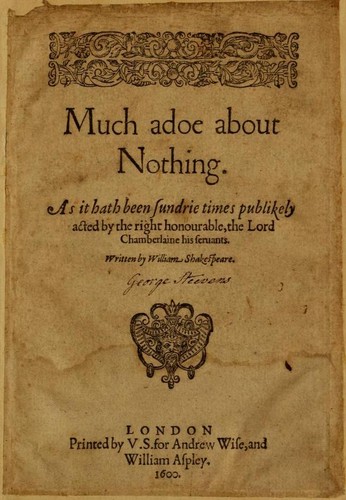
Much Ado About Nothing
William Shakespeare (1599)
“Shakespeare's sharpest romantic comedy asks whether the people who mock love the loudest are the ones who need it most.”
Language Register
Predominantly prose -- the most prose-heavy play in the Shakespeare canon. Verse appears for serious emotional moments and formal ceremonies, but the play's center of gravity is conversational, rapid, and intellectually competitive.
Syntax Profile
Prose dominates, with sentences built for speed, reversal, and competitive exchange. Beatrice and Benedick speak in balanced antitheses -- thrust and parry, claim and counter-claim -- that mirror fencing. The syntax is designed for performance: short enough to be delivered as rapid dialogue, complex enough to reward a second hearing. Verse appears in the shaming scene and in moments of genuine emotional crisis, signaling that the comic prose-world has been breached.
Figurative Language
Moderate but precisely targeted. The play's central image clusters: war/combat (love as battle, wit as weaponry), disease/infection (slander as poison that spreads through a community), appearance/surface (oranges rotten inside, masked faces, veiled brides). Shakespeare uses fewer extended metaphors than in the tragedies but deploys individual images with surgical effect -- 'rotten orange,' 'Kill Claudio,' 'taming my wild heart.'
Era-Specific Language
A man whose wife is unfaithful -- the most devastating social label for a man in Elizabethan England, carrying public shame and ridicule
Prostitute or woman of loose virtue -- Claudio's accusation of Hero uses this word as a weapon of maximum social destruction
A worn-out horse, applied to women as a term of contempt implying sexual promiscuity or worthlessness
Thorough, downright -- intensifier used with negative terms ('arrant knave') that has no modern equivalent at the same force level
Virgin -- not merely 'young woman' but specifically a woman whose sexual purity is intact, the foundation of her social worth in this period
Elizabethan pronunciation made 'nothing' and 'noting' near-homonyms -- the title puns on the play's obsession with observation, overhearing, and taking note of appearances
How Characters Speak — Class & Identity
Beatrice
Brilliant, aggressive prose full of puns, inversions, and competitive one-upmanship. Shifts to verse only once -- when the shaming of Hero forces sincerity.
A woman of intelligence and social status who uses language as both weapon and shield. Her wit keeps the world at arm's length; her rare verse moments signal genuine vulnerability.
Benedick
Equally witty prose, but with more self-aware asides and soliloquies. His language tracks his transformation: defensive wit to comic self-contradiction to genuine moral seriousness.
A man whose identity is built on his reputation as a wit and a bachelor. His linguistic journey -- from 'I will die a bachelor' to 'Enough, I am engaged' -- is the play's central arc.
Claudio
Stiff, conventional verse about Hero's beauty. Shifts to harsh, commercial prose in the shaming scene ('rotten orange'). Very few lines that feel emotionally specific.
A young man whose emotional vocabulary is borrowed from social convention. He knows how courtship is supposed to sound but does not know how love actually feels. His language is always performing for an audience.
Dogberry
Malapropism-dense prose where every important word is the wrong word. 'Comprehend' for 'apprehend,' 'dissembly' for 'assembly,' 'aspicious' for 'suspicious.'
A man of low social status who desperately wants to sound important. His mangled language is comic but also structurally crucial: the truth is trapped inside words that nobody in authority can decode.
Hero
Very few lines -- among the least-speaking title-adjacent characters in Shakespeare. Speaks mostly in verse, mostly to confirm what others have said.
Her silence is the play's indictment. The woman at the center of the plot has almost no voice in it. She is spoken about, spoken for, and spoken against -- but rarely speaks.
Narrator's Voice
No narrator -- the play operates through dialogue, soliloquy, and the audience's ability to hold multiple layers of deception simultaneously. Shakespeare trusts the audience to see through the tricks faster than the characters, creating dramatic irony that is both comic (the gulling) and painful (the slander).
Tone Progression
Act I
Sparkling, competitive, playful
The world of Messina is established as witty, social, and pleasure-seeking. Danger exists only at the margins.
Acts II-III
Comic delight and gathering dread
The gulling scenes are pure comedy; Don John's plot runs underneath like a bass note that will eventually dominate.
Act IV
Devastating, raw, morally urgent
The shaming scene shatters the comic world. Beatrice's 'Kill Claudio' is the play's emotional peak -- comedy forced to confront its own limitations.
Act V
Restored but haunted
The comic resolution arrives but cannot fully heal what the shaming scene broke. The dance at the end is celebration with an undertone.
Stylistic Comparisons
- The Taming of the Shrew -- Shakespeare's earlier battle-of-the-sexes comedy, but where Shrew's gender politics are deeply uncomfortable, Much Ado gives Beatrice genuine agency and moral authority
- As You Like It -- Another comedy of love and wit in a temporary world (forest/Messina), but Rosalind controls her own plot where Beatrice must work through Benedick
- Othello -- Shakespeare's tragedy of slander and sexual jealousy, written a few years later. Claudio is Othello without the grandeur; Don John is Iago without the intelligence
Key Vocabulary from This Book
Notable words used in this text — click to see full definitions