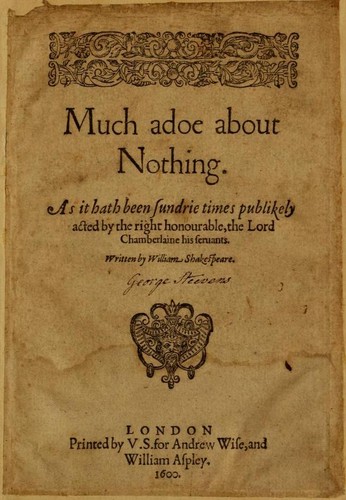
Much Ado About Nothing
William Shakespeare (1599)
“Shakespeare's sharpest romantic comedy asks whether the people who mock love the loudest are the ones who need it most.”
For Students
Because Beatrice and Benedick are the first version of every romantic comedy couple you have ever seen -- the ones who fight because they are afraid to feel, who use humor as armor, who need their friends to trick them into admitting what the audience already knows. The play is fast, funny, and genuinely witty in a way that rewards rereading. But it is also a play that gets suddenly, shockingly serious: the shaming of Hero is one of the most disturbing scenes in Shakespeare, and Beatrice's response -- 'Kill Claudio' -- is a moment that no comedy before or since has equaled for raw moral force. It is a play about love that takes love seriously enough to show what happens when trust fails.
For Teachers
The play is an ideal entry point for teaching Shakespeare because its prose-dominant texture is more accessible than the verse-heavy tragedies, while its thematic complexity (gender, honor, language, deception) supports advanced analysis at every level. The contrast between Beatrice/Benedick and Hero/Claudio is a natural essay structure. The shaming scene opens direct conversations about gender double standards, slander culture, and mob mentality that students find immediately relevant. Dogberry's malapropisms are an accessible way to teach how language shapes credibility and power. And the play's refusal to fully resolve its own tensions -- Hero's silence, Claudio's thin penance -- makes it a superb text for teaching how comedy can contain darkness.
Why It Still Matters
The play's core insight -- that public reputation can be destroyed by a lie faster than it can be restored by the truth -- is more relevant in the age of social media than it was in 1599. Hero's shaming is a sixteenth-century version of going viral for something you did not do: the accusation spreads instantly, the defense arrives too late, and the damage persists after the correction. Beatrice's fury at being unable to act because of her gender resonates wherever structural inequality determines who gets to speak and who must be spoken for. And the Beatrice-Benedick love story endures because it captures something true about how real relationships work: not through grand gestures and love-at-first-sight, but through two people who challenge each other into becoming braver than they would be alone.