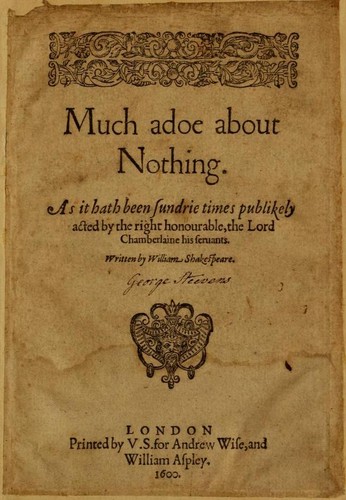
Much Ado About Nothing
William Shakespeare (1599)
“Shakespeare's sharpest romantic comedy asks whether the people who mock love the loudest are the ones who need it most.”
Much Ado About Nothing— Historical Context & Author Background
Author: William Shakespeare · Published 1599· Era: Renaissance / Elizabethan·80 pages
Themes explored: love-obsession, deception, honor, gender, appearance, language
About William Shakespeare
William Shakespeare (1564-1616) wrote Much Ado About Nothing around 1598-1599, during the peak of his comic mastery -- the same period that produced As You Like It and Twelfth Night. He was thirty-four, a successful playwright and shareholder in the Lord Chamberlain's Men, living in London while his family remained in Stratford. His marriage to Anne Hathaway, eight years his senior and married when he was eighteen, has been endlessly speculated about: Was it happy? Was it conventional? The play's portrait of marriage as both desirable and dangerous, its sympathy for women trapped by male assumptions, and its insistence that the best partnerships are between equals may reflect a writer who had thought carefully about what marriage actually requires versus what convention says it should be.
Life → Text Connections
How William Shakespeare's real experiences shaped specific elements of Much Ado About Nothing.
Shakespeare was writing at the height of the 'war of the theatres' -- rival playwrights attacking each other in print and on stage with elaborate wit combats
Beatrice and Benedick's 'merry war' mirrors the competitive, performance-driven culture Shakespeare inhabited daily
The play's obsession with wit as social currency reflects a theatrical world where verbal brilliance was professional survival. Shakespeare knew what it felt like to live by one's tongue.
Shakespeare's company performed regularly before Queen Elizabeth, who famously declared she would never marry and built political power on her independence
Beatrice's resistance to marriage -- 'I had rather hear my dog bark at a crow than a man swear he loves me' -- echoes Elizabeth's public posture of proud independence
The Elizabethan audience would have heard Beatrice's anti-marriage wit partly through the lens of their unmarried queen. A woman refusing marriage was both politically charged and culturally resonant.
English law in the 1590s gave husbands nearly total legal authority over wives -- property, movement, and social standing all depended on the husband's word
The shaming scene, where Hero is destroyed by male testimony with no opportunity to defend herself, and Leonato's immediate acceptance of the accusation over his daughter's denial
Shakespeare was not inventing the power dynamic; he was dramatizing the legal and social reality that a woman's word carried less weight than a man's in matters of reputation and honor.
Shakespeare had a daughter, Judith, who would later face a public scandal when her fiance was found to have fathered a child with another woman -- the shame fell on her, not him
The play's insistence that the shame of sexual accusation falls entirely on the woman, while the accuser faces no consequence until proven wrong
The double standard Shakespeare dramatizes in Much Ado was the double standard his own daughter would live under. The play's anger at the system is not abstract.
Historical Era
Late Elizabethan England, c. 1598-1599 -- the final years of Elizabeth I's reign, a period of cultural confidence and political anxiety
How the Era Shapes the Book
Much Ado About Nothing is a product of a culture where honor was not metaphorical but lethal. A public accusation of unchastity could destroy a woman's life -- not figuratively but literally, through social ostracism, loss of marriage prospects, and family disgrace. The shaming scene is not melodrama; it is an accurate depiction of what happened when the honor system was weaponized. Similarly, Benedick's challenge to Claudio is not a plot device but a real social mechanism: when a man's honor was impugned, the duel was the formal remedy. Shakespeare sets the play in Italy to give himself distance from English specifics, but the honor dynamics are entirely English and entirely real.
Why Much Ado About Nothing Matters Historically
Much Ado About Nothing is the foundational text of the romantic comedy as we know it. The formula it establishes -- two people who obviously belong together but cannot admit it, forced into revelation through the interference of friends, complications, and their own stubbornness -- is the template for virtually every romantic comedy written since. From Pride and Prejudice to When Harry Met Sally, the Beatrice-Benedick dynamic is the pattern. It is also Shakespeare's most modern play in its treatment of gender: Beatrice's anger at the structural powerlessness of women, expressed in language that feels contemporary four centuries later, makes it a text that speaks directly to ongoing conversations about gender, power, and voice.
- Established the 'bickering couple who secretly love each other' as the central romantic comedy archetype
- Created the first female character in English drama whose wit is presented as superior to the male lead's -- Beatrice consistently wins the exchanges
- Pioneered the comic 'overhearing' plot structure that would dominate comedy for centuries
- Dogberry is the prototype of every well-meaning but incompetent authority figure in comedy, from Inspector Clouseau to Michael Scott
Much Ado About Nothing has not been banned but has been regularly bowdlerized. Victorian productions cut Margaret's bawdy jokes, softened Beatrice's aggression, and shortened the shaming scene to reduce its violence. Many school editions historically excised the sexual humor (particularly the jokes about cuckoldry and horns) and downplayed the play's anger at patriarchal honor culture. The play's frank treatment of slander, sexual reputation, and gendered violence has made it occasionally controversial in educational settings.