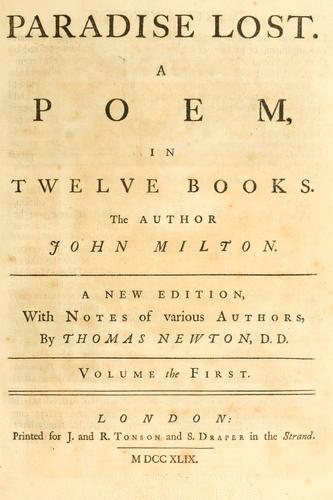
Paradise Lost
John Milton (1667)
“The poem that made Satan the most compelling character in English literature — and then asked whether you were wrong to find him compelling.”
At a Glance
Satan, cast out of Heaven after a failed rebellion against God, journeys through Chaos to the newly created Earth to corrupt humanity. He finds Adam and Eve in the Garden of Eden and, disguised as a serpent, persuades Eve to eat from the Tree of Knowledge. Adam eats too, choosing to fall with his wife rather than live without her. God pronounces judgment: death enters the world, and Adam and Eve are expelled from Paradise. But the poem ends with a promise of redemption — the Son of God will one day restore what was lost. They leave Eden hand in hand, with 'all the world before them.'
Read full summary →Why This Book Matters
Paradise Lost is the greatest long poem in the English language and the only English epic that stands alongside Homer, Virgil, and Dante in the Western canon. It established blank verse as the supreme form of English poetry, invented the modern literary Satan, and posed the problem of free will in terms that have shaped theology, philosophy, and literature for nearly four centuries. Every subsequent English poem written in blank verse — from Wordsworth's Prelude to T.S. Eliot's Waste Land — exists in its shadow.
Diction Profile
The most formally elevated sustained verse in English — Latinate syntax, periodic sentences, inverted word order, classical allusion on every page. Milton writes English as if it were Latin, and the result is a register that has no peer in the language.
Extraordinarily high. Milton's epic similes are the most sustained in English