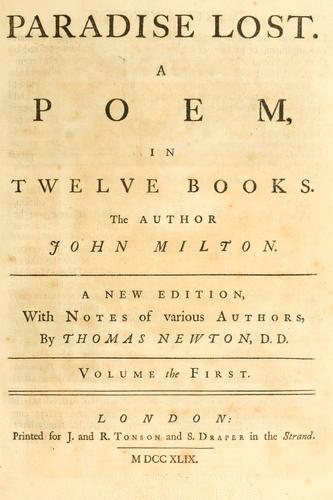
Paradise Lost
John Milton (1667)
“The poem that made Satan the most compelling character in English literature — and then asked whether you were wrong to find him compelling.”
Language Register
The most formally elevated sustained verse in English — Latinate syntax, periodic sentences, inverted word order, classical allusion on every page. Milton writes English as if it were Latin, and the result is a register that has no peer in the language.
Syntax Profile
Milton's blank verse (unrhymed iambic pentameter) is the most syntactically complex in English. Sentences regularly run eight, ten, fifteen lines before reaching their main verb — the opening sentence of the poem is sixteen lines long. The word order is heavily Latinate: adjectives follow nouns, verbs are delayed, subordinate clauses pile up before the main clause resolves. The effect is of thought building through qualifications, conditions, and parenthetical expansions before arriving at its conclusion. This is not decorative complexity — it enacts the poem's argument that reality is layered, that truth requires patience, that understanding comes after the full sentence is parsed.
Figurative Language
Extraordinarily high. Milton's epic similes are the most sustained in English — single comparisons that extend for ten, fifteen, twenty lines, generating their own narrative momentum. Satan is compared to a whale, a vulture, a wolf, a cormorant, a toad — each comparison carrying moral and visual weight. The similes do not merely illustrate; they create parallel narratives that comment on the main action. The Leviathan simile in Book I (Satan compared to a sea-beast that sailors mistake for an island) is a complete story in miniature about the danger of misreading appearances — which is exactly the poem's central theme.
Era-Specific Language
Relating to the highest heaven, the realm of pure fire and light — Milton's word for the divine dwelling place, drawn from medieval cosmology
'Formerly' or 'once' — archaic even in 1667, used to give the verse a deliberately antique gravity
Milton's spelling of 'sovereign' — he insisted on etymologically precise spellings that reflected Latin and Italian origins
Telescope — Milton met Galileo in 1638 and references his astronomical discoveries throughout, using contemporary scientific vocabulary
'Punished by fine or penalty' — legal vocabulary drawn into theological context, part of Milton's treatment of the Fall as a legal proceeding
How Characters Speak — Class & Identity
Satan
High epic register in public speeches (Books I-II) — Latinate, periodic, rhetorically overwhelming. Private soliloquies (Book IV) break into shorter, anguished syntax. The gap between public performance and private agony widens as the poem progresses.
Satan is a performer whose public rhetoric increasingly diverges from his inner reality. By Book IX he has shrunk from cosmic rebel to garden pest. His language tracks the decline.
God the Father
Abstract, declarative, logical. Short sentences by Milton's standards. No metaphor, no imagery, no persuasion. Statements of fact.
God does not need to persuade because God defines reality. The absence of rhetorical ornament is theologically consistent — omniscience does not argue — but dramatically flat. This is Milton's most debated stylistic choice.
Adam
Thoughtful, questioning verse — grammatically complex but emotionally warm. His speech to Raphael about Eve is his most rhetorically elaborate. His post-Fall speech is raw, broken, desperate.
Adam's language tracks his psychological state with precision. Pre-Fall: curious, reasonable, loving. Post-Fall: guilty, accusatory, despairing. The syntax itself falls with him.
Eve
Sensory, concrete, grounded in the physical world. Her first speech is about her own reflection in a pool. Her temptation scene shows her logic following Satan's rhetoric step by step.
Eve's language is more immediate than Adam's — less abstract, more embodied. Milton makes this both her strength (she experiences the world directly) and her vulnerability (she is more susceptible to sensory persuasion).
Raphael
Accommodated speech — an angel translating divine reality into human comprehension. He explicitly warns Adam that he is using metaphor: 'what surmounts the reach / Of human sense, I shall delineate so, / By likening spiritual to corporeal forms.'
Milton addresses the epistemological problem of his own poem through Raphael: how can language describe what language cannot contain? The angel's disclaimer is Milton's disclaimer.
Narrator's Voice
Milton's narrator is himself — blind, aging, politically defeated, dictating the poem to amanuenses (scribes who wrote down his words). The invocations that open Books I, III, VII, and IX are among the poem's most personal passages. 'Me, of these / Nor skilled nor studious, higher argument / Remains.' The narrator claims divine inspiration while acknowledging human limitation. He compares himself to Orpheus, to the nightingale, to Homer — blind poets who sang in darkness. The autobiographical pressure is immense: Milton is writing the poem he believes God called him to write, and he is doing it blind, in political disgrace, after the cause he devoted his life to has been destroyed.
Tone Progression
Books I-II
Magnificent, seductive, dangerous
Satan's rhetoric dominates. The verse is at its most musically powerful. The reader is being tempted alongside Eve.
Books III-IV
Theological exposition, then pastoral beauty and private anguish
Heaven is austere; Eden is lush; Satan's soliloquy cracks the heroic facade.
Books V-VIII
Didactic, narrative, intimate
Raphael's visit — cosmic history told in a domestic setting. The tone warms as Adam and Eve converse.
Book IX
Tragic, devastating, intimate
The Fall. Milton announces the shift to tragedy explicitly. The verse moves from elaborate temptation to monosyllabic catastrophe.
Books X-XII
Bleak, prophetic, ultimately hopeful
Judgment, despair, reconciliation, vision. The poem moves from personal tragedy to cosmic history and ends in restrained hope.
Stylistic Comparisons
- Homer's Iliad and Odyssey — Milton's direct models for epic structure, simile technique, and heroic register, deliberately surpassed in scope (cosmic vs. national)
- Virgil's Aeneid — Milton's primary Latin model, especially for the underworld journey and the relationship between divine will and human action
- Dante's Divine Comedy — The other great Christian epic poem, but Dante uses terza rima and first-person pilgrimage where Milton uses blank verse and omniscient narration
- Shakespeare's tragedies — Milton and Shakespeare were near-contemporaries; Milton's Satan shares rhetorical DNA with Iago and Macbeth, but Milton gives evil a philosophical coherence Shakespeare does not
Key Vocabulary from This Book
Notable words used in this text — click to see full definitions