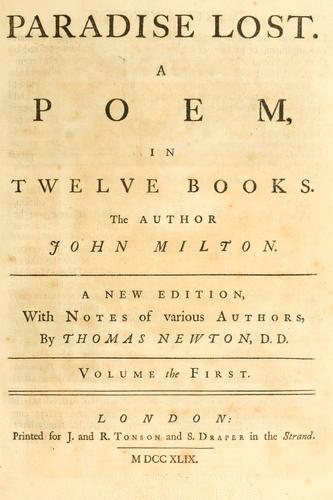
Paradise Lost
John Milton (1667)
“The poem that made Satan the most compelling character in English literature — and then asked whether you were wrong to find him compelling.”
Essay Questions & Food for Thought
30questions designed to challenge assumptions and provoke original thinking. These can't be answered from a summary — you need the actual text.
Satan's 'Better to reign in Hell than serve in Heaven' is the poem's most quoted line. Is it a statement of genuine freedom, or is it the rhetoric of self-deception? What does Satan actually gain by 'reigning in Hell'?
William Blake wrote that 'Milton was of the Devil's party without knowing it.' Stanley Fish argued that Milton knew exactly what he was doing and designed Satan to seduce the reader. Which reading do you find more convincing, and what textual evidence supports your position?
Milton was completely blind when he composed Paradise Lost. How does his blindness appear in the poem, and how does it shape the way he describes visual experience — particularly Eden, Heaven, and Hell?
Adam eats the fruit not because he is deceived but because he cannot bear to live without Eve. Is this a nobler reason to fall than Eve's intellectual curiosity? Does Milton present Adam's motive as more or less sympathetic than Eve's?
Eve argues that untested virtue is not genuine virtue — that she and Adam should be able to face temptation alone. Milton himself made the same argument in Areopagitica. Is Eve right? Is Milton arguing against his own principles?
God the Father speaks in plain, declarative statements with no rhetorical ornament. Satan speaks in the most elaborate, beautiful verse in the poem. What is Milton saying about the relationship between eloquence and truth?
Milton chose blank verse — unrhymed iambic pentameter — and explicitly defended this choice in a prefatory note, calling rhyme 'the invention of a barbarous age.' Why was this decision revolutionary, and how does the absence of rhyme affect the reading experience?
Paradise Lost is an epic poem about obedience to God, written by a man who helped overthrow a king. How do Milton's political experiences — serving Cromwell, surviving the Restoration, narrowly escaping execution — shape the poem's treatment of authority and rebellion?
The poem ends: 'They hand in hand, with wandering steps and slow, / Through Eden took their solitary way.' Is this ending hopeful or despairing? What does 'solitary' mean when applied to two people walking together?
Satan says 'The mind is its own place, and in itself / Can make a Heaven of Hell, a Hell of Heaven.' Later he admits 'Which way I fly is Hell; myself am Hell.' How do these two statements relate to each other? Which is true?
Milton's epic similes are among the longest in English poetry — single comparisons that extend for ten or twenty lines. Choose one extended simile and analyze what it adds beyond simple illustration. How does the simile create a parallel narrative?
Mary Shelley's Frankenstein directly references Paradise Lost — the Monster reads it and identifies with both Adam and Satan. Why would a creature rejected by his creator see himself in Milton's poem? Which identification is more accurate?
Raphael tells Adam to 'Be lowly wise: / Think only what concerns thee and thy being.' Milton spent his entire life pursuing knowledge relentlessly. Is there a contradiction between what Milton's character says and what Milton's life demonstrates?
Sin and Death are allegorical characters — literal personifications who guard the gates of Hell and build a bridge to Earth. Why does Milton include allegory in an otherwise realistic narrative? What do Sin and Death accomplish that could not be accomplished by abstract description?
Satan's followers in the infernal council each represent a different political response to defeat: Moloch (war), Belial (inaction), Mammon (building an alternative civilization). Map these to modern political positions. Which is most recognizable today?
Milton explicitly celebrates married sexual love in Book IV: 'Hail, wedded Love.' This was radical for a Puritan poet in 1667. Why? What was the prevailing Christian attitude toward sexuality, and how does Milton challenge it?
The poem's opening sentence is sixteen lines long. Read it aloud. What is the effect of delaying the main verb for that long? How does Milton's syntax enact the experience of epic scale?
Abdiel stands alone against Satan's rebel host and is mocked for his loyalty. Milton writes: 'Among the faithless, faithful only he.' Why does Milton give this minor character such a prominent moral position? What does Abdiel represent?
The concept of the 'fortunate fall' (felix culpa) suggests that the Fall was ultimately beneficial because it led to Christ's redemption. Does Paradise Lost endorse this idea? Can something be simultaneously catastrophic and ultimately good?
Satan is compared to a toad (Book IV), a cormorant, a wolf, and a serpent at various points. Track his animal imagery across the poem. What pattern emerges? What does the progression from lion to toad say about Milton's view of evil?
Paradise Lost contains several 'stories within the story': the War in Heaven, the Creation, the visions of future history. Why does Milton embed narratives within his narrative? What does this layered structure accomplish?
Philip Pullman's His Dark Materials rewrites Paradise Lost with the Fall as liberation rather than catastrophe. Does anything in Milton's own poem support this reading? Could the Fall be read as freedom?
Milton met Galileo in 1638. Galileo was under house arrest for arguing that the Earth orbits the Sun. How does this encounter appear in the poem, and what does it say about the relationship between knowledge, authority, and punishment?
Satan's temptation of Eve works through a chain of logical steps: the serpent ate the fruit and lived; therefore God's threat of death is false; therefore the prohibition is arbitrary; therefore eating is an act of liberation. Identify the logical fallacy at each step.
The poem has been called 'an epic written in defense of obedience by a man who spent his life in disobedience.' Is this a contradiction, or is Milton distinguishing between kinds of obedience and kinds of authority?
Compare Satan's soliloquy in Book IV ('O thou that with surpassing glory crowned') to any of his public speeches in Book I. How does his language change when he has no audience? What does the difference reveal?
'She plucked, she ate.' The most consequential action in human history occupies five monosyllables. Why does Milton strip the moment of all rhetorical elaboration? What is the effect of plainness after thousands of lines of complex verse?
Milton's gender politics are explicitly hierarchical: 'He for God only, she for God in him.' But Eve makes the poem's most important decision and initiates the reconciliation that saves the marriage. Does the poem's action support or undermine its stated gender hierarchy?
Every major English poet after Milton has had to reckon with Paradise Lost. Choose one (Wordsworth, Blake, Shelley, Keats, Eliot, or another) and explain how they responded to Milton's influence — through imitation, opposition, or transformation.
Satan says rebellion against God is a fight for liberty. Modern political movements use similar rhetoric: every revolution claims to be fighting tyranny. Does Paradise Lost help you evaluate when 'liberty' rhetoric is genuine and when it is self-serving? How?