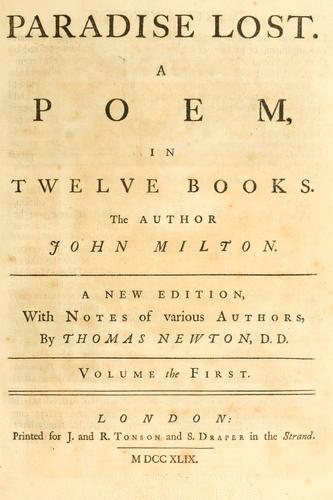
Paradise Lost
John Milton (1667)
“The poem that made Satan the most compelling character in English literature — and then asked whether you were wrong to find him compelling.”
Why This Book Matters
Paradise Lost is the greatest long poem in the English language and the only English epic that stands alongside Homer, Virgil, and Dante in the Western canon. It established blank verse as the supreme form of English poetry, invented the modern literary Satan, and posed the problem of free will in terms that have shaped theology, philosophy, and literature for nearly four centuries. Every subsequent English poem written in blank verse — from Wordsworth's Prelude to T.S. Eliot's Waste Land — exists in its shadow.
Firsts & Innovations
First major English poem to use blank verse for epic narrative — Milton's rejection of rhyme was revolutionary and permanently altered the trajectory of English poetry
Created the modern literary Satan — the charismatic, complex, rhetorically brilliant villain who is more interesting than the hero, a character type that descends directly to every antihero in Western fiction
First epic poem in English that is genuinely philosophical rather than merely narrative — Paradise Lost argues theology, epistemology, and political theory while telling its story
Established the 'Miltonic' style — long periodic sentences, Latinate syntax, epic simile — that became the dominant mode of serious English verse for two centuries
Cultural Impact
William Blake's claim that 'Milton was of the Devil's party without knowing it' (The Marriage of Heaven and Hell, 1793) launched two centuries of debate about whether Satan is the poem's true hero — a debate that is itself the poem's greatest achievement
The Romantic poets (Blake, Shelley, Byron, Keats) read Satan as a revolutionary hero and modeled their own poetic personae on his defiance — Prometheus, the Byronic hero, and the Romantic outcast all descend from Milton's Satan
Mary Shelley's Frankenstein (1818) is structured as a direct response to Paradise Lost — the Monster reads it and identifies with both Adam and Satan
Philip Pullman's His Dark Materials trilogy (1995-2000) is an explicit retelling of Paradise Lost that reverses Milton's theology, treating the Fall as liberation rather than catastrophe
'Better to reign in Hell than serve in Heaven' has become a proverb quoted by everyone from entrepreneurs to revolutionaries, usually without awareness of its original ironic context
Every English-language poet since Milton has had to reckon with Paradise Lost: Wordsworth imitated it, Pope parodied it, T.S. Eliot analyzed it, and no one has surpassed it
Banned & Challenged
Paradise Lost was not formally banned but was politically dangerous at publication. Milton's earlier prose works had been publicly burned by the hangman in 1660 after the Restoration. The poem's implicit parallels between Satan's rebellion and the English Revolution were obvious to contemporary readers. Various religious authorities have periodically objected to Milton's humanization of Satan and his unorthodox theology (Milton rejected the Trinity, believed in a mortal soul that dies with the body, and argued for divorce and polygamy in his prose works). The poem has been excluded from some religious curricula for making Satan too sympathetic.