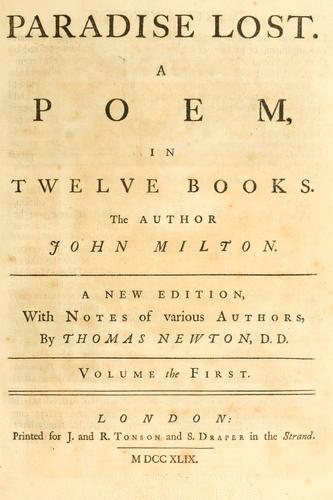
Paradise Lost
John Milton (1667)
“The poem that made Satan the most compelling character in English literature — and then asked whether you were wrong to find him compelling.”
Similar Books
Thematic connections across eras and genres — books that talk to each other.
Frankenstein
Mary Shelley
Shelley's Monster reads Paradise Lost and identifies with both Adam and Satan. Frankenstein is a direct response to Milton's poem — a story about a creature abandoned by its creator who turns to destruction, asking the same questions about responsibility, free will, and the consequences of knowledge.
Milton's primary epic model. The Odyssey established the conventions — invocation, epic simile, divine council, narrative flashback — that Milton adopted and transformed. Reading Homer alongside Milton reveals what Milton kept and what he revolutionized.
Macbeth
William Shakespeare
Shakespeare's most Miltonic play, though it predates Milton. Macbeth and Satan share the same psychological architecture: both know exactly what they are doing is wrong, both do it anyway, and both are destroyed by the gap between their ambition and their conscience.
Hamlet
William Shakespeare
Where Paradise Lost asks what happens when you choose to act wrongly, Hamlet asks what happens when you cannot act at all. Both are fundamentally about the relationship between knowledge, will, and moral action — and both suggest that too much knowledge can be paralyzing.
Crime and Punishment
Fyodor Dostoevsky
Raskolnikov's belief that he is an 'extraordinary man' exempt from moral law echoes Satan's conviction that his superiority justifies rebellion. Both works anatomize the psychology of self-justified transgression — and both insist that the transgressor destroys himself.
Oedipus Rex
Sophocles
Both works center on the relationship between knowledge and catastrophe. Oedipus's pursuit of truth destroys him; Eve's pursuit of knowledge causes the Fall. Both ask whether there are things humans are better off not knowing — and both are written by authors who clearly believe the answer is no.