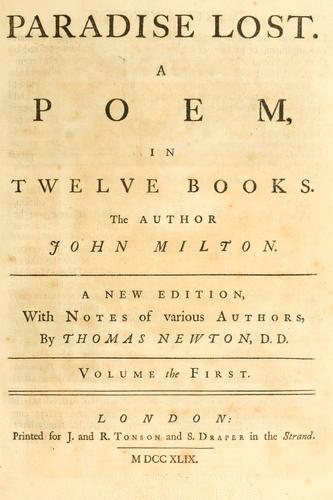
Paradise Lost
John Milton (1667)
“The poem that made Satan the most compelling character in English literature — and then asked whether you were wrong to find him compelling.”
Paradise Lost— Historical Context & Author Background
Author: John Milton · Published 1667· Era: Renaissance·453 pages
Themes explored: freedom, fate, power, good-vs-evil, ambition, knowledge, sacrifice
About John Milton
John Milton (1608-1674) wrote Paradise Lost between approximately 1658 and 1663, publishing it in 1667. He was completely blind by 1652 and dictated the entire poem to amanuenses — scribes who wrote down his words as he spoke them. He had served as Latin Secretary to Oliver Cromwell's revolutionary Puritan government, which had executed King Charles I in 1649 and established a republic. When the monarchy was restored in 1660 under Charles II, Milton was arrested, briefly imprisoned, and narrowly escaped execution. He was politically disgraced, financially ruined, and physically blind. Paradise Lost was composed by a man who had devoted his life to a political revolution that failed, was blind, was living under a hostile government, and believed God had called him to write the greatest poem in the English language. The poem's obsessive engagement with defeat, defiance, free will, and the meaning of political failure is inseparable from Milton's biography.
Life → Text Connections
How John Milton's real experiences shaped specific elements of Paradise Lost.
Milton was completely blind by 1652. He dictated Paradise Lost to amanuenses — daughters, friends, hired scribes — who wrote down his spoken words.
The invocations in Books I, III, and VII contain Milton's most personal passages about his blindness. 'Thus with the year / Seasons return, but not to me returns / Day, or the sweet approach of even or morn.' He compares himself to Homer, Tiresias, and the nightingale singing in darkness.
The poem's reliance on internal vision — Milton cannot see the physical world and must construct Eden, Heaven, and Hell entirely from memory and imagination — gives Paradise Lost its distinctive texture. Everything is visualized with extraordinary precision because nothing is seen. The blind poet creates the most visually vivid poem in the language.
Milton served Cromwell's revolutionary government and wrote propaganda defending the execution of King Charles I. The Restoration of 1660 destroyed everything he had worked for politically.
Satan's rebellion against divine authority, the War in Heaven, the debate about tyranny and liberty, the fall of a great cause — all carry the imprint of Milton's political experience. Abdiel, the lone angel who stands against the rebel majority, is Milton's self-portrait.
Paradise Lost is written by a man who knows what it is like to fight for a cause, see it triumph, and then watch it collapse. The poem's treatment of defeat — Satan's, Adam's, Milton's own — is not theoretical. It is lived experience encoded in cosmic allegory.
Milton was a radical Puritan who believed in divorce (his first marriage was deeply unhappy), religious tolerance (for Protestants), republican government, and the absolute primacy of individual conscience over institutional authority.
The poem's insistence on free will, its suspicion of hierarchy (even while defending God's authority), its celebration of married love, and its portrait of Satan as a demagogue who uses liberty-rhetoric to pursue personal power
Milton's radicalism makes Paradise Lost permanently unstable: he believes in individual freedom so deeply that his portrait of Satan's rebellion against divine authority is more rhetorically compelling than his defense of obedience. The poem's greatest artistic achievement is also its deepest theological problem.
Milton met Galileo in Florence in 1638 — one of the few documented encounters between the two men. Galileo was under house arrest by the Inquisition for his astronomical theories.
Paradise Lost references telescopes ('optic glass'), the Copernican controversy, and the scale of the cosmos with a specificity that reflects Milton's direct engagement with the new science. Raphael's discussion of astronomy with Adam in Book VIII explicitly addresses the question of whether the Earth or the Sun is the center of the cosmos.
Milton's encounter with Galileo — a brilliant man imprisoned for seeking truth — resonates throughout the poem's treatment of knowledge, authority, and the danger of knowing too much. The poem sits precisely at the intersection of the old theological cosmos and the new scientific one.
Historical Era
English Restoration, 1660s — aftermath of the English Civil War, the Puritan Commonwealth, and the Restoration of the Stuart monarchy
How the Era Shapes the Book
Paradise Lost is a poem about a failed rebellion against divine authority, written by a man who participated in a failed rebellion against royal authority. Every line about Satan's defeat carries the weight of Milton's own political defeat. The poem's central question — was the rebellion justified? — is simultaneously theological (was Satan right to rebel against God?) and political (was Parliament right to rebel against the King?). Milton's answer is complex: Satan was wrong because God is genuinely just, but the rhetoric of rebellion is given such power that the poem implicitly argues for the right of conscience to challenge authority, even when that challenge fails. The Restoration context makes every word political: to write about overthrowing a king — even God — in 1667 was a dangerous act.
Why Paradise Lost Matters Historically
Paradise Lost is the greatest long poem in the English language and the only English epic that stands alongside Homer, Virgil, and Dante in the Western canon. It established blank verse as the supreme form of English poetry, invented the modern literary Satan, and posed the problem of free will in terms that have shaped theology, philosophy, and literature for nearly four centuries. Every subsequent English poem written in blank verse — from Wordsworth's Prelude to T.S. Eliot's Waste Land — exists in its shadow.
- First major English poem to use blank verse for epic narrative — Milton's rejection of rhyme was revolutionary and permanently altered the trajectory of English poetry
- Created the modern literary Satan — the charismatic, complex, rhetorically brilliant villain who is more interesting than the hero, a character type that descends directly to every antihero in Western fiction
- First epic poem in English that is genuinely philosophical rather than merely narrative — Paradise Lost argues theology, epistemology, and political theory while telling its story
- Established the 'Miltonic' style — long periodic sentences, Latinate syntax, epic simile — that became the dominant mode of serious English verse for two centuries
Paradise Lost was not formally banned but was politically dangerous at publication. Milton's earlier prose works had been publicly burned by the hangman in 1660 after the Restoration. The poem's implicit parallels between Satan's rebellion and the English Revolution were obvious to contemporary readers. Various religious authorities have periodically objected to Milton's humanization of Satan and his unorthodox theology (Milton rejected the Trinity, believed in a mortal soul that dies with the body, and argued for divorce and polygamy in his prose works). The poem has been excluded from some religious curricula for making Satan too sympathetic.