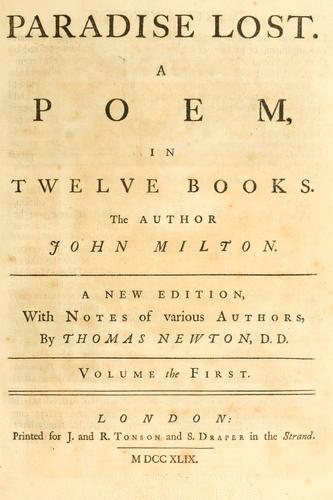
Paradise Lost
John Milton (1667)
“The poem that made Satan the most compelling character in English literature — and then asked whether you were wrong to find him compelling.”
Paradise Lost— Summary & Analysis
by John Milton · published 1667 · 453 pages · Renaissance
A user-friendly study guide for Paradise Lost by John Milton (1667): a high-level plot summary, full chapter-by-chapter analysis, theme breakdowns, character profiles, and 30 essay questions designed for ap-english, college readers. Unlike a stock summary, sumsumsum.com adds a diction analysis drawn from John Milton’s actual text, the 8 documented AP Literature exam appearances of this book, and reading-difficulty guidance (Moderate, 5/10) so students, teachers, and lifelong readers know what they are walking into.
“The poem that made Satan the most compelling character in English literature — and then asked whether you were wrong to find him compelling.”
Short Summary
Satan, cast out of Heaven after a failed rebellion against God, journeys through Chaos to the newly created Earth to corrupt humanity. He finds Adam and Eve in the Garden of Eden and, disguised as a serpent, persuades Eve to eat from the Tree of Knowledge. Adam eats too, choosing to fall with his wife rather than live without her. God pronounces judgment: death enters the world, and Adam and Eve are expelled from Paradise. But the poem ends with a promise of redemption — the Son of God will one day restore what was lost. They leave Eden hand in hand, with 'all the world before them.'
Detailed Summary
Paradise Lost opens not in Heaven or Eden but in Hell. Satan and his rebel angels have just lost a catastrophic war against God and lie stunned on a burning lake of fire. Satan is the first to recover. His opening speeches — magnificent, defiant, rhetorically overwhelming — establish the poem's cent...
Summary in the Author’s Writing Style
A retelling of Paradise Lost in John Milton’s style — so you can hear the language, not just the plot. This is a stylistic pastiche written by sumsumsum, not an excerpt from the book.
Sing, heavenly Muse, of that first disobedience and the long ruin loosed upon the world; and sing, too, of the blind man who, fallen from the cause he loved and groping in a darkness no morning would relieve, dictated these lines to other hands, trusting that what the eyes had lost the inward light …
Chapter-by-Chapter Analysis
If you liked Paradise Lost, read next
Start with The Odyssey by Homer — Milton's primary epic model. The Odyssey established the conventions — invocation, epic simile, divine council, narrative flashback — that Milton adopted and transformed. Reading Homer alongside Milton reveals what Milton kept and what he revolutionized.. Or pivot to Hamlet by William Shakespeare — Where Paradise Lost asks what happens when you choose to act wrongly, Hamlet asks what happens when you cannot act at all. Both are fundamentally about the relationship between knowledge, will, and moral action — and both suggest that too much knowledge can be paralyzing..
For comparative essays, pair Paradise Lost with
The strongest comparative pairing is Frankenstein (Mary Shelley) — Shelley's Monster reads Paradise Lost and identifies with both Adam and Satan. Frankenstein is a direct response to Milton's poem — a story about a creature abandoned by its creator who turns to destruction, asking the same questions about responsibility, free will, and the consequences of knowledge.. Another productive pairing is Macbeth (William Shakespeare) — Shakespeare's most Miltonic play, though it predates Milton. Macbeth and Satan share the same psychological architecture: both know exactly what they are doing is wrong, both do it anyway, and both are destroyed by the gap between their ambition and their conscience.. For a third angle, contrast with Crime and Punishment (Fyodor Dostoevsky) — Raskolnikov's belief that he is an 'extraordinary man' exempt from moral law echoes Satan's conviction that his superiority justifies rebellion. Both works anatomize the psychology of self-justified transgression — and both insist that the transgressor destroys himself..
Each of these pairings opens a clean thesis path on shared themes, period diction, or formal influence — useful for AP Lit / IB / first-year college comparative essays.