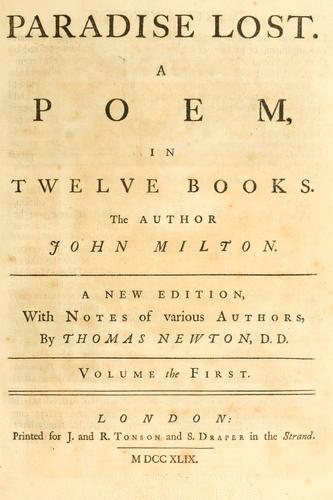
Paradise Lost
John Milton (1667)
“The poem that made Satan the most compelling character in English literature — and then asked whether you were wrong to find him compelling.”
For Students
Because Paradise Lost contains the most compelling villain in English literature, and Milton wants you to notice that you find him compelling — and then ask yourself why. The poem is a four-hundred-year-old test of the reader's moral attention: if you admire Satan's speeches without noticing what he is actually saying, you are falling the same way Eve does. The language is difficult — Milton writes English like it is Latin, and the sentences are long — but once you tune your ear to the rhythm, the poetry is physically overwhelming. Start with Satan's speeches in Books I and IV. If those do not move you, nothing will.
For Teachers
Paradise Lost is the richest teaching text in the English epic tradition. The Satan problem alone supports a full unit: Is Satan the hero? What does it mean that the villain has the best lines? Blake's 'Devil's party' reading vs. Stanley Fish's 'surprised by sin' reading — the critical debate is itself a masterclass in interpretive methodology. The blank verse decision — why Milton rejected rhyme, how that choice shaped the poem, what Dryden meant when he said Milton proved blank verse could work for epic — is a complete poetics unit. Gender, free will, the politics of obedience, the relationship between knowledge and sin — every major theme in the Western liberal arts curriculum runs through this poem.
Why It Still Matters
Every generation has its version of Satan's argument: that authority is tyranny, that disobedience is freedom, that the pursuit of knowledge should have no limits, that the charismatic rebel is always right. And every generation has its version of Milton's counter-argument: that not all authority is tyranny, that freedom without moral structure is self-destruction, and that the most dangerous lies are the ones that contain enough truth to be convincing. Paradise Lost is the poem for anyone who has ever been seduced by a beautiful argument and then discovered, too late, what it actually meant.