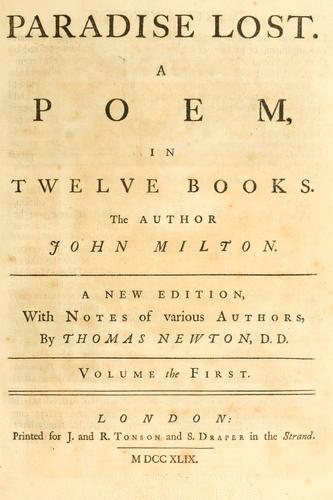
Paradise Lost
John Milton (1667)
“The poem that made Satan the most compelling character in English literature — and then asked whether you were wrong to find him compelling.”
This page prints on a single page. Use Ctrl+P / Cmd+P.
Paradise Lost
John Milton (1667) · 453pages · Renaissance · 8 AP appearances
Summary
Satan, cast out of Heaven after a failed rebellion against God, journeys through Chaos to the newly created Earth to corrupt humanity. He finds Adam and Eve in the Garden of Eden and, disguised as a serpent, persuades Eve to eat from the Tree of Knowledge. Adam eats too, choosing to fall with his wife rather than live without her. God pronounces judgment: death enters the world, and Adam and Eve are expelled from Paradise. But the poem ends with a promise of redemption — the Son of God will one day restore what was lost. They leave Eden hand in hand, with 'all the world before them.'
Why It Matters
Paradise Lost is the greatest long poem in the English language and the only English epic that stands alongside Homer, Virgil, and Dante in the Western canon. It established blank verse as the supreme form of English poetry, invented the modern literary Satan, and posed the problem of free will i...
Themes & Motifs
Diction & Style
Register: The most formally elevated sustained verse in English — Latinate syntax, periodic sentences, inverted word order, classical allusion on every page. Milton writes English as if it were Latin, and the result is a register that has no peer in the language.
Narrator: Milton's narrator is himself — blind, aging, politically defeated, dictating the poem to amanuenses (scribes who wrot...
Figurative Language: Extraordinarily high. Milton's epic similes are the most sustained in English
Historical Context
English Restoration, 1660s — aftermath of the English Civil War, the Puritan Commonwealth, and the Restoration of the Stuart monarchy: Paradise Lost is a poem about a failed rebellion against divine authority, written by a man who participated in a failed rebellion against royal authority. Every line about Satan's defeat carries t...
Key Characters
Talking Points
- Satan's 'Better to reign in Hell than serve in Heaven' is the poem's most quoted line. Is it a statement of genuine freedom, or is it the rhetoric of self-deception? What does Satan actually gain by 'reigning in Hell'?
- William Blake wrote that 'Milton was of the Devil's party without knowing it.' Stanley Fish argued that Milton knew exactly what he was doing and designed Satan to seduce the reader. Which reading do you find more convincing, and what textual evidence supports your position?
- Milton was completely blind when he composed Paradise Lost. How does his blindness appear in the poem, and how does it shape the way he describes visual experience — particularly Eden, Heaven, and Hell?
- Adam eats the fruit not because he is deceived but because he cannot bear to live without Eve. Is this a nobler reason to fall than Eve's intellectual curiosity? Does Milton present Adam's motive as more or less sympathetic than Eve's?
- Eve argues that untested virtue is not genuine virtue — that she and Adam should be able to face temptation alone. Milton himself made the same argument in Areopagitica. Is Eve right? Is Milton arguing against his own principles?
Notable Quotes
“Better to reign in Hell than serve in Heaven.”
“The mind is its own place, and in itself / Can make a Heaven of Hell, a Hell of Heaven.”
“What though the field be lost? / All is not lost: the unconquerable will, / And study of revenge, immortal hate, / And courage never to submit or y...”
Why Read This
Because Paradise Lost contains the most compelling villain in English literature, and Milton wants you to notice that you find him compelling — and then ask yourself why. The poem is a four-hundred-year-old test of the reader's moral attention: if...