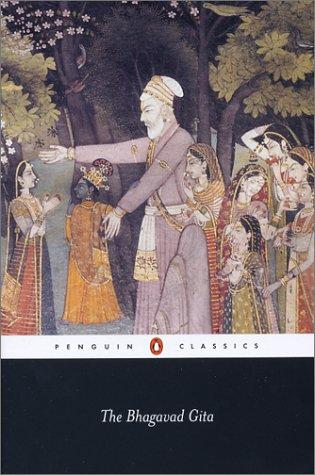
The Bhagavad Gita
Traditional (attributed to Vyasa, part of the Mahabharata) (-300)
“A warrior refuses to fight. A god explains why he must. Seven hundred verses that shaped how billions understand duty, death, and the meaning of action.”
This page prints on a single page. Use Ctrl+P / Cmd+P.
The Bhagavad Gita
Traditional (attributed to Vyasa, part of the Mahabharata) (-300) · 100pages · Ancient Indian / Classical Sanskrit · 2 AP appearances
Summary
On the battlefield of Kurukshetra, the warrior prince Arjuna refuses to fight a civil war against his own kinsmen. His charioteer, Krishna — revealed as the Supreme Being — delivers a philosophical dialogue across 18 chapters, teaching Arjuna that the soul is eternal, that action performed without attachment to results is the path to liberation, and that duty (dharma) must be fulfilled regardless of personal anguish. Arjuna resolves to fight.
Why It Matters
The Bhagavad Gita is arguably the single most influential text in Indian civilization — the closest analogue to what the Bible is in Western culture or the Quran in Islamic culture, though it functions differently from either. It has been continuously commented upon for over two thousand years, w...
Themes & Motifs
Diction & Style
Register: Elevated philosophical discourse rendered in metrical verse — the Sanskrit is simultaneously hymn, argument, and divine speech
Narrator: The Gita has a double frame: Sanjaya narrates to Dhritarashtra, and within that frame, Krishna speaks to Arjuna. The ...
Figurative Language: High
Historical Context
Late Vedic / Early Classical India, approximately 5th-2nd century BCE: The Gita is a product of philosophical crisis. The old Vedic religion of ritual sacrifice was losing authority. Buddhism and Jainism offered radical alternatives — renounce the world entirely. The ...
Key Characters
Talking Points
- Krishna argues that because the soul is eternal, killing the body is not truly killing. Is this argument morally sound? Could it be used to justify any violence — or does the Gita place limits on when this reasoning applies?
- The Gita presents three paths to liberation — karma yoga (action), jnana yoga (knowledge), and bhakti yoga (devotion). Are these truly equal alternatives, or does the text subtly favor one? Trace the evidence.
- Arjuna's crisis begins as a specific military dilemma but becomes an existential one. At what point does the dialogue shift from 'should I fight this war?' to 'how should a person live?' Why does the Gita need both levels?
- Oppenheimer quoted 'I am become Death, the destroyer of worlds' after the Trinity nuclear test. Is this an appropriate use of the Gita? Does the atomic bomb context distort or illuminate the original meaning?
- The concept of nishkama karma — action without attachment to results — is the Gita's most famous teaching. Is this psychologically possible? Can a surgeon, soldier, or student truly act without caring about the outcome?
Notable Quotes
“Never was there a time when I did not exist, nor you, nor all these kings; nor in the future shall any of us cease to be.”
“You have a right to perform your prescribed duties, but you are not entitled to the fruits of your actions.”
“As a person puts on new garments, giving up old ones, the soul similarly accepts new material bodies, giving up the old and useless ones.”
Why Read This
Because the Gita is one of the foundational texts of world philosophy, and you cannot understand Indian civilization, comparative religion, or the history of ideas without it. It asks the question every person eventually faces — 'What should I do ...