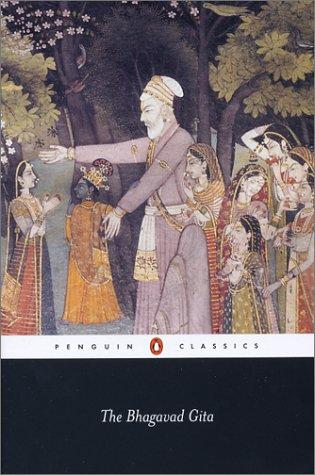
The Bhagavad Gita
Traditional (attributed to Vyasa, part of the Mahabharata) (-300)
“A warrior refuses to fight. A god explains why he must. Seven hundred verses that shaped how billions understand duty, death, and the meaning of action.”
Language Register
Elevated philosophical discourse rendered in metrical verse — the Sanskrit is simultaneously hymn, argument, and divine speech
Syntax Profile
The original Sanskrit anushtubh meter (32 syllables per verse, 8 per quarter) gives the text a rhythmic, memorizable quality. English translations range from Victorian blank verse (Edwin Arnold) to plain prose (Radhakrishnan) to devotional clarity (Easwaran, Prabhupada). The Gita alternates between Krishna's extended philosophical discourses and Arjuna's sharp, often anxious questions — creating a dialectical rhythm of teaching and resistance.
Figurative Language
High — the Gita uses extended metaphors (the body as garment, the mind as wind, the world as inverted tree), analogies (the tortoise withdrawing its limbs), and cosmic imagery (thousand suns, infinite mouths) to make abstract philosophy sensory and memorable.
Era-Specific Language
Duty, righteousness, cosmic law, moral order — the term is untranslatable because it encompasses all of these simultaneously
Not physical postures but 'discipline' or 'union' — the yoking of the self to the divine through action, knowledge, or devotion
The individual soul or self, distinct from the body and the mind, eternal and indestructible
Action and its consequences — not fate but the accumulated results of past choices that shape present circumstances
The three fundamental qualities of nature: sattva (clarity), rajas (passion), tamas (inertia) — everything material is a mixture of all three
Liberation from the cycle of birth and death — the Gita's ultimate goal, achieved through knowledge, action, or devotion
The absolute, infinite, unchanging reality — the ground of all existence, variously understood as personal God or impersonal principle
How Characters Speak — Class & Identity
Krishna
Authoritative, intimate, and versatile — shifts from philosophical argument to cosmic declaration to tender personal address within single chapters.
The divine voice contains all registers. Krishna can be teacher, friend, cosmic terror, and beloved — the Gita's theology expressed through tonal range.
Arjuna
Begins articulate and despairing, grows increasingly humble and direct, ends with decisive clarity.
The student's voice matures through the dialogue. His early speeches are elaborate and rhetorical; his final words are simple and resolved.
Sanjaya
Narrative frame — reportorial and reverent, occasionally breaking into personal awe.
The witness who transmits sacred knowledge. His awe authenticates the vision for both Dhritarashtra and the reader.
Dhritarashtra
A single opening question — then silence for the rest of the text.
The blind king who chose not to see. His silence after the opening verse is itself a commentary on willful ignorance.
Narrator's Voice
The Gita has a double frame: Sanjaya narrates to Dhritarashtra, and within that frame, Krishna speaks to Arjuna. The reader occupies Dhritarashtra's position — hearing sacred teaching through a mediator, unable to see the battlefield directly. This structure makes the act of reception itself a spiritual exercise.
Tone Progression
Chapters 1-2
Crisis, grief, consolation
Arjuna's despair meets Krishna's metaphysical calm. The emotional temperature is highest at the start — everything that follows is a response to a man who has dropped his weapons.
Chapters 3-6
Systematic, dialectical, practical
The three yogas are laid out with increasing specificity. The tone is professorial — teacher and student working through objections methodically.
Chapters 7-12
Revelatory, devotional, sublime
The theological climax. Krishna reveals his divine nature, the Universal Form terrifies, and bhakti emerges as the path of love. The tone shifts from instruction to awe.
Chapters 13-18
Synthetic, authoritative, culminating
The final synthesis. The gunas, renunciation, and surrender are woven together. The tone is valedictory — a teacher delivering his last and most important words.
Stylistic Comparisons
- The Book of Job — divine speech answering human suffering with cosmic perspective rather than comfort
- Plato's Dialogues — philosophical truth arrived at through dialectical conversation between teacher and student
- The Tao Te Ching — another ancient text using paradox and brevity to express the inexpressible
- Marcus Aurelius's Meditations — similar emphasis on duty, detachment, and finding inner peace amid worldly obligation
Key Vocabulary from This Book
Notable words used in this text — click to see full definitions