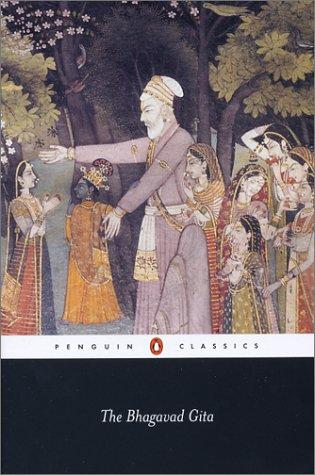
The Bhagavad Gita
Traditional (attributed to Vyasa, part of the Mahabharata) (-300)
“A warrior refuses to fight. A god explains why he must. Seven hundred verses that shaped how billions understand duty, death, and the meaning of action.”
The Bhagavad Gita— Summary & Analysis
by Traditional (attributed to Vyasa, part of the Mahabharata) · published -300 · 100 pages · Ancient Indian / Classical Sanskrit
A user-friendly study guide for The Bhagavad Gita by Traditional (attributed to Vyasa, part of the Mahabharata) (-300): a high-level plot summary, full chapter-by-chapter analysis, theme breakdowns, character profiles, and 30 essay questions designed for ap-english, college readers. Unlike a stock summary, sumsumsum.com adds a diction analysis drawn from Traditional (attributed to Vyasa, part of the Mahabharata)’s actual text, the 2 documented AP Literature exam appearances of this book, and reading-difficulty guidance (Moderate, 4/10) so students, teachers, and lifelong readers know what they are walking into.
“A warrior refuses to fight. A god explains why he must. Seven hundred verses that shaped how billions understand duty, death, and the meaning of action.”
Short Summary
On the battlefield of Kurukshetra, the warrior prince Arjuna refuses to fight a civil war against his own kinsmen. His charioteer, Krishna — revealed as the Supreme Being — delivers a philosophical dialogue across 18 chapters, teaching Arjuna that the soul is eternal, that action performed without attachment to results is the path to liberation, and that duty (dharma) must be fulfilled regardless of personal anguish. Arjuna resolves to fight.
Detailed Summary
The Bhagavad Gita ('Song of the Lord') is a 700-verse dialogue embedded within the sixth book of the Mahabharata, the great Indian epic. The setting is the field of Kurukshetra, moments before a catastrophic civil war between two branches of the same royal family: the Pandavas (Arjuna's side) and th...
Summary in the Author’s Writing Style
A retelling of The Bhagavad Gita in Traditional (attributed to Vyasa, part of the Mahabharata)’s style — so you can hear the language, not just the plot. This is a stylistic pastiche written by sumsumsum, not an excerpt from the book.
Then said the blind king to his charioteer: tell me what came to pass upon the field of righteousness, the field of Kurukshetra, where my sons and the sons of Pandu stood gathered, eager for war. And Sanjaya answered, O king, hear now what I beheld, for I have been given sight of all that passed the…
Chapter-by-Chapter Analysis
If you liked The Bhagavad Gita, read next
Start with Meditations by Marcus Aurelius — A ruler's private philosophical journal on duty, death, and equanimity — Stoic detachment parallels the Gita's teaching on action without attachment. Then try The Book of Job by Traditional (Hebrew Bible) — Another text where a suffering human confronts the divine and receives an answer that overwhelms rather than explains — cosmic perspective as response to human anguish. Or pivot to Siddhartha by Hermann Hesse — A Western novelist's encounter with Indian philosophy — the search for enlightenment through experience rather than teaching, directly engaging the Gita's world.
For comparative essays, pair The Bhagavad Gita with
The strongest comparative pairing is Tao Te Ching (Laozi) — Another ancient text using paradox and brevity to express the inexpressible — complementary Eastern philosophical traditions addressing the same questions of action, detachment, and the nature of reality. For a third angle, contrast with Walden (Henry David Thoreau) — Thoreau took the Gita to Walden Pond — his experiment in deliberate living is a direct response to the Gita's teaching on simplicity, detachment, and self-knowledge.
Each of these pairings opens a clean thesis path on shared themes, period diction, or formal influence — useful for AP Lit / IB / first-year college comparative essays.