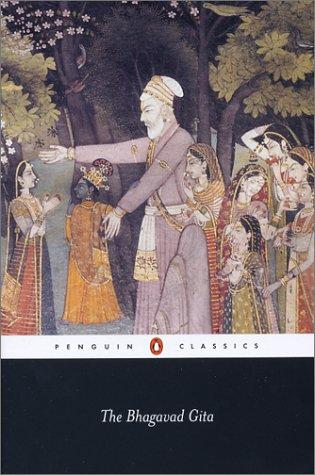
The Bhagavad Gita
Traditional (attributed to Vyasa, part of the Mahabharata) (-300)
“A warrior refuses to fight. A god explains why he must. Seven hundred verses that shaped how billions understand duty, death, and the meaning of action.”
Essay Questions & Food for Thought
30questions designed to challenge assumptions and provoke original thinking. These can't be answered from a summary — you need the actual text.
Krishna argues that because the soul is eternal, killing the body is not truly killing. Is this argument morally sound? Could it be used to justify any violence — or does the Gita place limits on when this reasoning applies?
The Gita presents three paths to liberation — karma yoga (action), jnana yoga (knowledge), and bhakti yoga (devotion). Are these truly equal alternatives, or does the text subtly favor one? Trace the evidence.
Arjuna's crisis begins as a specific military dilemma but becomes an existential one. At what point does the dialogue shift from 'should I fight this war?' to 'how should a person live?' Why does the Gita need both levels?
Oppenheimer quoted 'I am become Death, the destroyer of worlds' after the Trinity nuclear test. Is this an appropriate use of the Gita? Does the atomic bomb context distort or illuminate the original meaning?
The concept of nishkama karma — action without attachment to results — is the Gita's most famous teaching. Is this psychologically possible? Can a surgeon, soldier, or student truly act without caring about the outcome?
The Gita has been claimed by both pacifists (Gandhi) and warriors (the Indian military). How can the same text support non-violence AND fighting? Is this a flaw in the text or a feature?
Krishna's Universal Form (Chapter 11) terrifies Arjuna rather than comforting him. Why does the Gita make the direct experience of God frightening rather than beautiful? What does this say about the nature of the divine?
The Gita teaches that the three gunas (sattva, rajas, tamas) shape all human behavior. Apply this framework to your own life: what activities do you do in a sattvic state? Rajasic? Tamasic? Is the framework useful as psychology?
Dhritarashtra asks a single question and then falls silent for the entire text. Why does the Gita need this blind, silent audience? What does his presence add that Krishna-Arjuna alone would lack?
Verse 9.32 says women, merchants, and laborers can attain liberation through devotion. Is this verse emancipatory (everyone can reach God) or condescending (these groups need special permission)? How does your reading depend on your assumptions?
Compare the Gita's teaching on duty (dharma) to Kant's categorical imperative ('act only according to maxims you could will to be universal laws'). Where do they agree? Where do they diverge?
The Gita is embedded within the Mahabharata — an epic full of morally ambiguous characters and tragic consequences. How does knowing the war's outcome (massive destruction, pyrrhic victory) affect your reading of Krishna's encouragement to fight?
Thoreau, Emerson, and the American Transcendentalists were deeply influenced by the Gita. What specific ideas in the Gita connect to Transcendentalist themes like self-reliance, the oversoul, and civil disobedience?
The Gita's final instruction is 'Abandon all varieties of dharma and simply surrender unto Me.' After 17 chapters of detailed ethical teaching, why does Krishna end by telling Arjuna to let it all go? Is this a contradiction or a culmination?
How does the Gita's dialogue form — teacher answering a student's real objections — compare to Plato's dialogues? What are the strengths and limits of philosophy conducted as conversation rather than treatise?
The Gita describes the demonic nature in Chapter 16: obsessed with acquisition, convinced they are self-made, contemptuous of others. Does this portrait describe any modern cultural types? Is the Gita's diagnosis of ego-driven behavior still accurate?
B.R. Ambedkar, the architect of India's constitution and a Dalit rights leader, criticized the Gita for reinforcing caste hierarchy through the concept of varna-dharma. Is this criticism valid? Can the Gita be separated from its caste implications?
The Gita uses the body-as-garment metaphor for reincarnation. What does this metaphor include and what does it leave out? What would change if the Gita compared death to sleep, or to a caterpillar becoming a butterfly?
The Gita teaches equanimity — equal response to pleasure and pain, success and failure. Is this emotionally healthy or is it emotional suppression? How does the Gita's ideal compare to modern psychological concepts like emotional regulation?
Why does the Gita set its philosophical teaching on a battlefield rather than in a temple, forest, or ashram? What does the extreme setting add to the philosophy that a peaceful setting could not?
The Gita has been translated into English over 300 times. Compare any two translations of the same verse (2.47, 4.7-8, 11.32, or 18.66). How do the translators' word choices reflect different philosophical or devotional priorities?
The Gita influenced both Gandhi's non-violence and the militant Hindu nationalism of some modern political movements. How can the same text be credibly claimed by both? What does this tell us about the nature of sacred texts?
Krishna says 'Even a little progress on this path protects one from the greatest fear.' What is 'the greatest fear'? Is it death, meaninglessness, moral failure, or something else? How does the Gita's answer compare to what you personally consider the greatest fear?
Analyze the Gita as a work of dramatic literature rather than philosophy. What is the dramatic arc? Where is the climax? How does the tension build and resolve? Is it effective as storytelling?
Compare Krishna's teaching on detachment to Stoic philosophy (Marcus Aurelius, Epictetus). Both traditions teach equanimity in the face of events beyond our control. Where do they converge, and where does the Gita go beyond Stoicism?
The Gita was composed orally and designed for recitation. How would hearing it spoken aloud — in a temple, in a family gathering, on a battlefield — change the experience compared to reading it silently in a classroom? What is lost in translation from performance to text?
Arjuna's objection to fighting includes the argument that destroying families corrupts women and disrupts ancestral rites. Are these arguments taken seriously by the text, or does Krishna dismiss them? What does the Gita's treatment of Arjuna's social concerns reveal about its priorities?
The inverted cosmic tree (Chapter 15) has roots above and branches below. Find similar images in other traditions — the Kabbalistic Tree of Life, the Norse Yggdrasil, the Buddhist Bodhi Tree. What does the 'cosmic tree' archetype reveal about how humans imagine the structure of reality?
The Gita's teaching on the gunas divides all food, faith, charity, and action into three categories. Is this framework reductive (oversimplifying human complexity) or clarifying (providing useful categories for self-analysis)? Test it against your own experience.
The Gita ends with Arjuna resolved to fight — and the Mahabharata goes on to describe a war of apocalyptic destruction. If the Gita's teaching leads to a devastating war, is the teaching validated or undermined by its consequences?