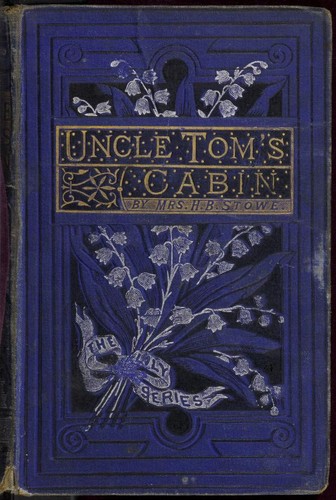
Uncle Tom's Cabin
Harriet Beecher Stowe (1852)
“The novel that Abraham Lincoln supposedly said started the Civil War — a sentimental masterpiece that weaponized empathy to dismantle the moral foundations of American slavery.”
Uncle Tom's Cabin— Historical Context & Author Background
Author: Harriet Beecher Stowe · Published 1852· Era: Romantic / Antebellum·530 pages
Themes explored: slavery, christianity, motherhood, race, humanity, moral-suasion, resistance
About Harriet Beecher Stowe
Harriet Beecher Stowe (1811-1896) was the daughter of Lyman Beecher, one of America's most prominent Calvinist ministers, and grew up in a family that treated moral questions as matters of life and death. She lived in Cincinnati, Ohio — directly across the river from the slave state of Kentucky — for eighteen years, where she witnessed the realities of slavery and the fugitive slave trade firsthand. She harbored escapees, interviewed formerly enslaved people, and absorbed the testimonies that would fuel her novel. The Fugitive Slave Act of 1850, which compelled Northern citizens to assist in capturing escapees, enraged her into writing. She composed Uncle Tom's Cabin as a serial for the National Era newspaper in 1851-52, reportedly telling her family that God wrote it through her. The novel sold 300,000 copies in its first year — an unprecedented figure — and made Stowe the most famous woman in America. She spent the rest of her career defending the novel's accuracy and advocating for abolition, but never again produced a work of comparable impact.
Life → Text Connections
How Harriet Beecher Stowe's real experiences shaped specific elements of Uncle Tom's Cabin.
Stowe lived in Cincinnati, directly across the Ohio River from slave-state Kentucky, and witnessed fugitive escapes firsthand
Eliza's crossing of the Ohio River — the most famous scene in the novel — is drawn from documented accounts Stowe collected in Cincinnati
The Ohio River was the literal boundary between freedom and slavery. Stowe's geographic position gave her both proximity to slavery and the moral perspective of someone who lived outside it.
Stowe's infant son Charlie died of cholera in 1849; she later wrote that the grief helped her understand what enslaved mothers felt when children were sold
The novel's obsessive focus on maternal grief — Eliza's terror, Cassy's infanticide, Eva's death — draws directly on Stowe's own loss
Stowe converted personal grief into political argument. Her most effective rhetorical strategy — asking white mothers to imagine their children being sold — was rooted in her own experience of losing a child.
The Beecher family was deeply religious and politically engaged — seven of Lyman's sons became ministers; sister Catherine was a prominent educator
The novel's theological framework — slavery as sin, suffering as redemption, Christian love as the only force capable of defeating evil
Stowe's Calvinism shaped the novel's entire moral architecture. She genuinely believed that slavery was a sin against God and that its abolition was a religious obligation, not merely a political one.
Stowe drew on Josiah Henson's autobiography and Frederick Douglass's Narrative, among other slave narratives, for documentary detail
Tom's experiences, the descriptions of plantation labor, the slave auction scenes, and the details of the Underground Railroad all reflect testimony Stowe collected
The novel's power derived partly from its evidentiary base. Stowe published A Key to Uncle Tom's Cabin in 1853, documenting her sources to refute charges of exaggeration.
Historical Era
1850s America — Antebellum period, Fugitive Slave Act, intensifying sectional crisis
How the Era Shapes the Book
The Fugitive Slave Act of 1850 was the novel's direct provocation. By requiring Northerners to participate in capturing escapees, the law destroyed the fiction that slavery was a distant Southern problem. Stowe wrote Uncle Tom's Cabin to make that complicity visceral rather than abstract — to force Northern readers to feel what the law required them to do. The novel was published during the most politically volatile decade in American history, and it accelerated the sectional crisis by converting millions of uncommitted Northerners into opponents of slavery's expansion.
Why Uncle Tom's Cabin Matters Historically
Uncle Tom's Cabin was the bestselling novel of the nineteenth century, outsold only by the Bible in America during the 1850s. It sold 300,000 copies in its first year and over a million copies worldwide by 1853. Abraham Lincoln's reported greeting to Stowe — 'So you're the little woman who wrote the book that started this great war' — is apocryphal but captures a real truth: the novel transformed American public opinion on slavery more effectively than any political speech, sermon, or pamphlet. It was the first American novel to take slavery as its central subject and the first to achieve genuine mass cultural saturation, spawning theatrical adaptations ('Tom shows'), merchandise, songs, and a visual iconography that persisted for decades.
- First American novel to sell over a million copies — established the bestseller as a cultural force
- First major work of American fiction to center the experiences of enslaved people, however imperfectly
- Pioneered the use of sentimental fiction as deliberate political propaganda — the novel as activist tool
- First American novel to generate a significant international political response — influenced British opinion against supporting the Confederacy
Banned throughout the antebellum South — possession was a criminal offense in some states. Pro-slavery advocates burned copies and published over thirty 'anti-Tom' novels in response. In the twentieth century, the novel was challenged from the opposite direction: Civil Rights-era critics objected to its racial stereotypes, paternalism, and the 'Uncle Tom' archetype. It remains controversial in classrooms — assigned for its historical importance while requiring careful contextualization of its racial politics.