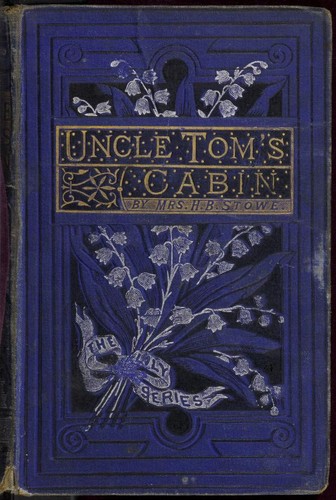
Uncle Tom's Cabin
Harriet Beecher Stowe (1852)
“The novel that Abraham Lincoln supposedly said started the Civil War — a sentimental masterpiece that weaponized empathy to dismantle the moral foundations of American slavery.”
Language Register
Formal Victorian prose with heavy narrator intervention, alternating with phonetically rendered dialect for enslaved characters
Syntax Profile
Long, flowing sentences in narrative passages, with heavy use of em-dashes, semicolons, and parenthetical asides. Stowe's narrator is interventionist — she breaks the fictional frame regularly to address the reader, lecture on moral points, and direct emotional responses. Dialogue is sharply differentiated by race and class: educated white characters speak in standard Victorian English; enslaved characters speak in phonetically rendered dialect. This dialect transcription, while reflecting actual speech patterns Stowe recorded, also reinforces racial hierarchy through the visual markers of 'incorrect' English on the page.
Figurative Language
Moderate — Stowe relies more on direct emotional appeal and narrative situation than on metaphor. When figurative language appears, it is predominantly biblical: allegory, typology, and explicit parallels to Christ's passion, the Exodus, and the Psalms. The novel's major symbols (the cabin, the river, Eva's hair, Tom's Bible) function through repetition rather than complexity.
Era-Specific Language
Euphemism for slavery, used by both defenders and critics
Dialect rendering of 'Master' — marks enslaved speech and the power relationship embedded in language itself
Slave trader — the commercial vocabulary that reduced people to commodities
Renting enslaved people to other slaveholders — slavery as a financial instrument
Tom's recurring invocation — Christian resignation that Stowe intended as heroic and that subsequent readers have found troubling
How Characters Speak — Class & Identity
Uncle Tom
Heavy dialect rendered phonetically — 'Mas'r,' 'an't,' 'ye.' Increasingly biblical as the novel progresses, drawing directly on King James Version cadences.
Stowe uses dialect to mark Tom's social position while using biblical language to elevate his spiritual authority above every white character in the novel. The tension between the two registers IS the character.
Augustine St. Clare
Epigrammatic, witty, philosophical. Long, balanced sentences with ironic reversals. The language of a man who has substituted intellect for conscience.
Southern aristocratic education deployed as a defense mechanism. St. Clare talks brilliantly about slavery to avoid doing anything about it.
Simon Legree
Blunt, profane, imperative. Short sentences dominated by commands and threats. Physical language — he speaks with his fists as much as his mouth.
The complete collapse of civilized pretense. Legree doesn't justify slavery philosophically — he exercises it physically. His language is power without ornament.
George Harris
Educated, passionate, drawing on Enlightenment rhetoric and Revolutionary-era political language. Speaks in full standard English.
Stowe gives George the language of the Founding Fathers to make her point that denying him freedom is denying America's own principles. His eloquence is a political argument.
Topsy
Heavy dialect, fragmented syntax, comic rhythm. Language patterns drawn partly from minstrel traditions.
The most problematic voice in the novel. Stowe uses minstrel-adjacent speech to portray a child damaged by slavery, but the comedic framing has been used to dehumanize rather than humanize.
Narrator's Voice
Omniscient, interventionist, and openly didactic. Stowe's narrator is not a character but a moral authority who addresses the reader directly, interprets events, assigns blame, and demands emotional response. The narrator breaks the fourth wall constantly — 'And you, mothers of America' — refusing to let the reader maintain aesthetic distance. This technique was attacked by literary critics as artistically crude and praised by abolitionists as politically essential.
Tone Progression
Chapters 1-10
Domestic, urgent, alternating hope and terror
The Kentucky chapters establish the human stakes through family separation. Eliza's flight is paced like a thriller; Tom's departure is paced like a funeral.
Chapters 11-26
Philosophical, sentimental, increasingly elegiac
The St. Clare chapters slow into debate, comedy, and spiritual reflection. Eva's death shifts the tone to sustained grief and moral urgency.
Chapters 27-43
Gothic, brutal, prophetic
The Legree chapters darken into horror. Physical violence replaces philosophical conversation. Tom's martyrdom restores religious grandeur.
Chapters 44-45
Polemical, direct, demanding
The final chapters abandon fiction for political argument. Stowe speaks in her own voice, converting narrative energy into calls to action.
Stylistic Comparisons
- Charles Dickens — shared sentimentalism, interventionist narrator, social reform purpose, but Dickens's comedy is richer and his politics less radical
- Frederick Douglass's Narrative — the enslaved person's own voice, without white mediation or sentimental framing. The necessary corrective to Stowe's perspective
- Nathaniel Hawthorne — same era, opposite method. Hawthorne uses allegory and ambiguity where Stowe uses directness and moral certainty
Key Vocabulary from This Book
Notable words used in this text — click to see full definitions